Fire Protection in Data Centres: Containment Without Operational Compromise
Fire Protection in Data Centres: Containment Without Operational Compromise
A data hall expansion adds cable routes, cooling connections and power distribution equipment. Each installation may cross a fire boundary, alter access arrangements or change the conditions around existing protection.
The challenge is to accommodate that growth while preserving the separation and essential functions established by the fire strategy.
Passive fire protection needs to work with cooling, power resilience and maintenance. Its specification should address the facility as an interconnected operating system, with clear controls for later alterations.
Define the Boundaries Around the Actual Risks
Identify where separation is needed between data halls, electrical rooms, plant areas, service routes and adjoining occupancies.
The required construction should follow the fire strategy, applicable requirements and assessed consequences of failure. A standard wall rating applied throughout the facility may overlook differences in exposure and protected functions.
For fire protection systems, define the required duration and performance criteria for each boundary.
Include the complete enclosure: walls, floors, ceilings where relevant, doors, ventilation openings and penetrations. Separation is only as continuous as its interfaces.
Treat Cable Penetrations as Managed Assets
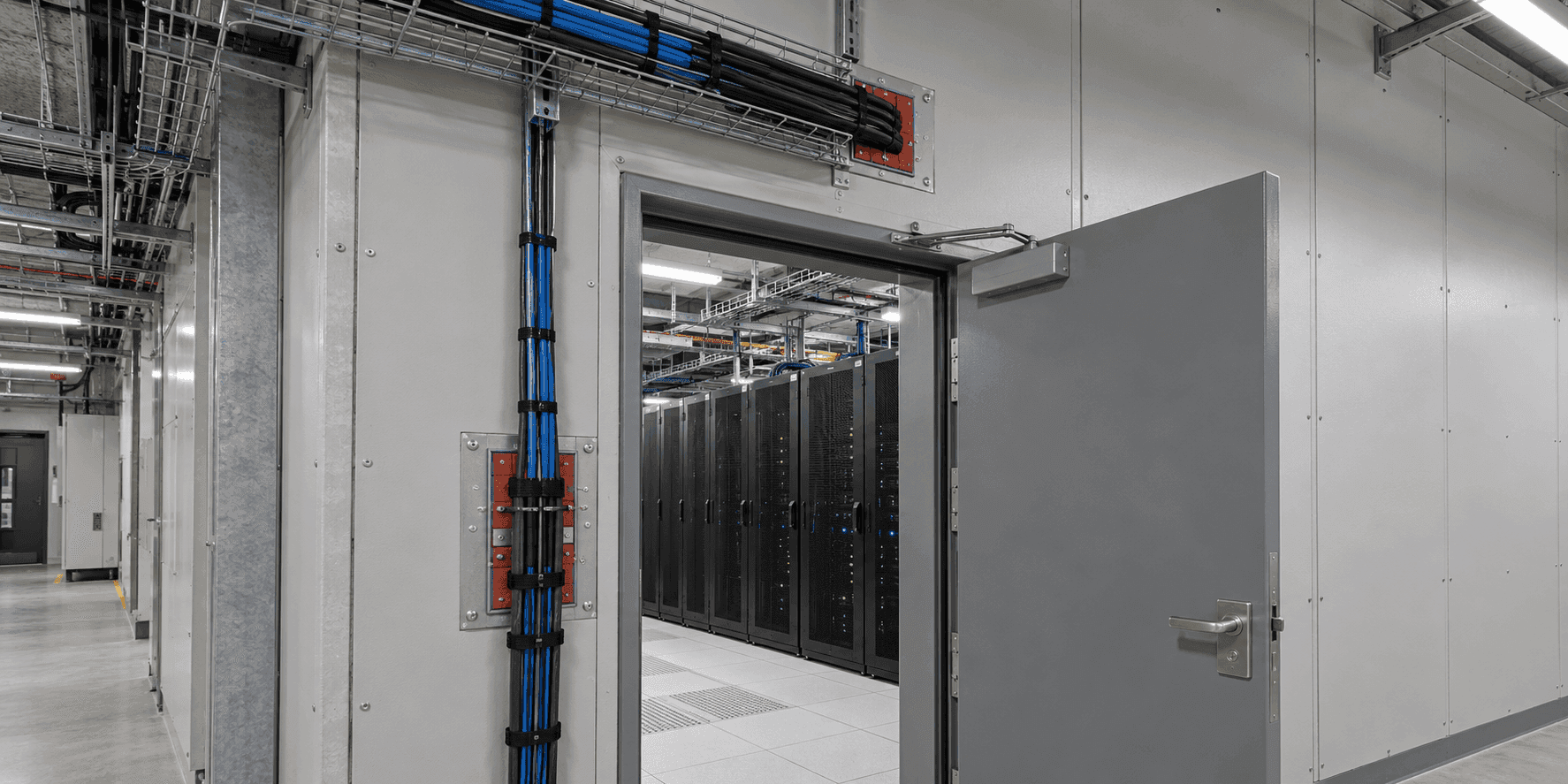
Data centres undergo frequent cable additions and replacements. Penetration design should accommodate foreseeable changes through arrangements covered by appropriate evidence.
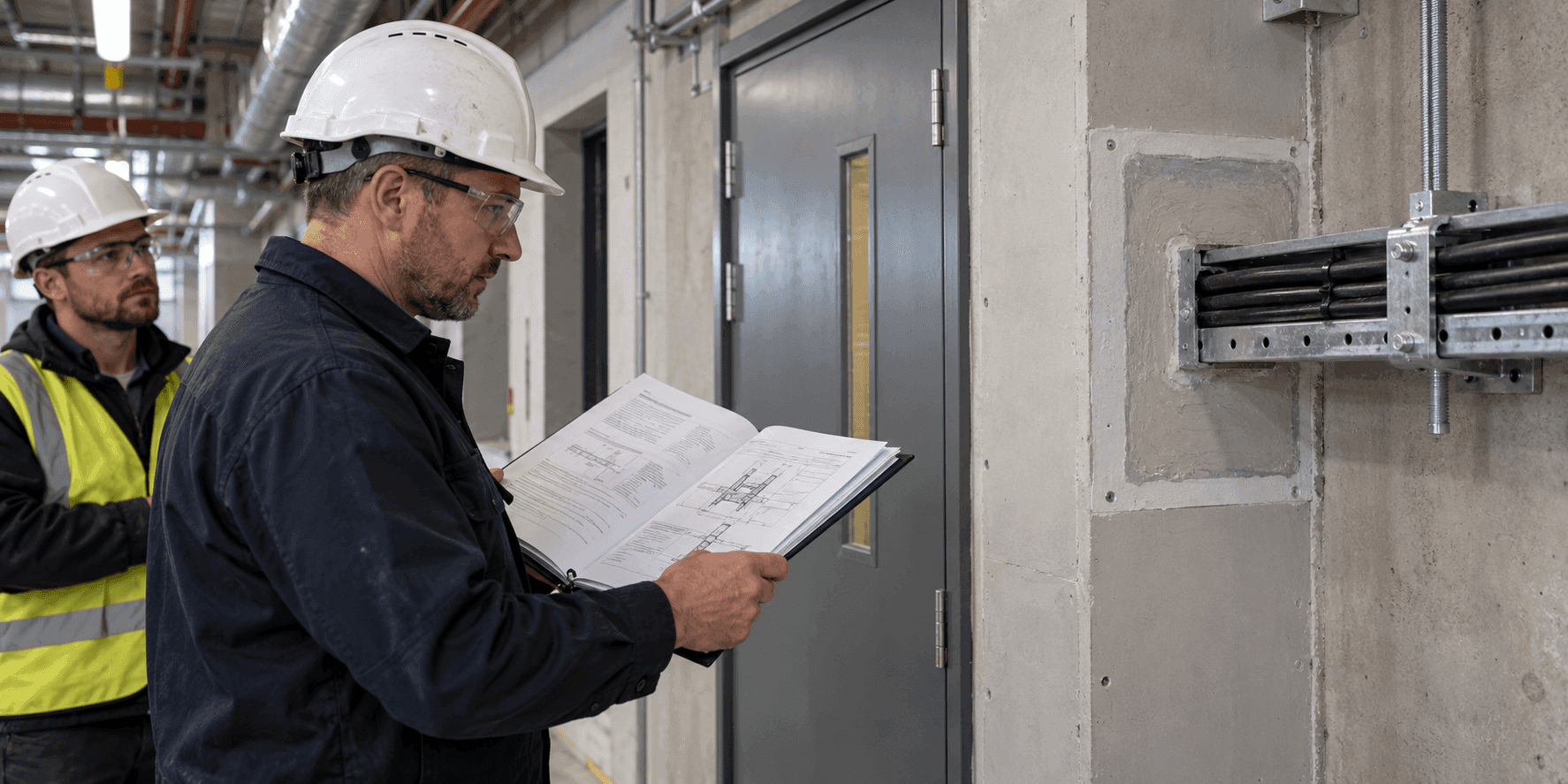
Check cable types, tray construction, opening dimensions, supporting wall or floor and permitted installation limits. Spare space does not automatically establish capacity for additional services.
Assign each penetration an identifiable location and approved detail. Require work orders to address opening, temporary conditions, reinstatement and inspection.
A completed cable installation should not be closed out until the affected fire boundary has also been restored and verified.
Specify Smoke Leakage Where It Matters
Fire resistance does not automatically establish smoke tightness.
Sensitive equipment may be affected by smoke outside the area of direct flame exposure. Where smoke limitation is an objective, specify suitable leakage performance and compatible interface details.
FM’s data-centre guidance distinguishes fire-resistance performance from leakage-rated penetration sealing, which addresses smoke passage before high-temperature exposure.
Consider adjacent spaces and shared service routes as well as individual openings. A sealed penetration cannot compensate for another unprotected path through the same boundary.
Coordinate Cooling and Suppression Interfaces
Cooling systems can connect otherwise separated spaces through ducts, pipes and plenums.
Determine how each opening behaves during the incident. Coordinate dampers, fire-resisting construction, controls and access with the intended emergency sequence.
Where gaseous suppression is used, enclosure integrity and pressure-relief provisions need coordination with the compartment boundary. Fire resistance alone does not demonstrate agent retention.
Avoid treating hot-aisle or cold-aisle containment as fire compartmentation unless the complete arrangement has the required evidence. Airflow management and fire separation serve different duties.
Review Power Infrastructure Separately
Generators, transformers and associated distribution systems introduce hazards and dependencies beyond the data hall.
For generator room fire protection, coordinate fuel arrangements, ventilation, exhaust routes, access and service penetrations with the required separation.
For fire protection for transformer rooms, consider transformer type, credible exposure, adjacent equipment and the consequences of damage. Do not assume every transformer installation presents the same hazard.
Where battery systems are present, identify their chemistry, configuration and assessed failure scenarios. A generic fire rating does not establish protection against every battery-related consequence.
Preserve Genuine Independence Between Systems
Redundant equipment can remain vulnerable if its supplies or controls share an exposed route.
Review common cable paths, risers, junctions and plant spaces. Establish whether separation, protected routing or another measure is needed to address common-cause failure.
A fire-rated cable protection system requires evidence appropriate to the intended circuit function and installation. Include supports, branches and terminations.
Also check normal-service conditions. Enclosing cables can affect heat dissipation and may require electrical assessment alongside fire-performance review.
Maintain Protection Through Every Change
Design access so maintenance teams can inspect services without damaging the surrounding protection. Removable sections need defined reinstatement details.
Before an upgrade, assess the affected boundaries and essential-system dependencies. Inspect completed work and update the asset records.
Retain approved drawings, evidence references, penetration schedules and repair requirements in a usable handover package.
Data-centre resilience depends on continued coordination between protection and operations. Fire boundaries support that objective when they remain complete, service changes are controlled and the installed arrangements continue to match their performance evidence.