Tunnel Fire Protection: A Race Against Time
From smoke movement and evacuation to structural performance and passive protection, understanding what happens in the first critical minutes of a tunnel fire is key to designing for the time that matters.
The moment a fire starts inside a tunnel, the clock starts.
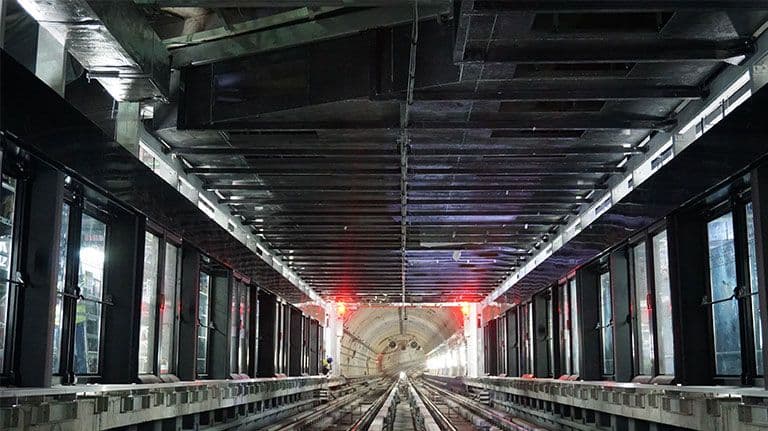
A tunnel is a very different environment from a conventional building. It is confined, escape routes are limited, emergency access can be difficult, and smoke and heat can travel considerable distances from the point of ignition. Ventilation can influence how smoke moves, while the fire itself may continue to grow as occupants are trying to understand what is happening and get to safety.
Of course, no two tunnel fires develop in exactly the same way. Tunnel geometry, ventilation, fire location, vehicle type, fuel load, fire size and duration all influence the event. But the underlying engineering problem remains the same: there is only a limited amount of time for the tunnel's fire-safety measures to do what they are designed to do.
Let's look at what the tunnel is actually trying to achieve in the minutes after a fire starts.
When People Are Getting Out
For occupants, the immediate threat may not be structural failure. It may be the loss of a tenable environment.
As a fire develops, hot smoke rises and spreads along the tunnel. Depending on the ventilation strategy and the location and size of the fire, smoke can be driven downstream or move back upstream towards the fire, a phenomenon known as back-layering. At the same time, people need to recognise the incident, leave their vehicles or work areas, find an escape route and reach a place of safety.
This makes tenability a critical part of tunnel fire engineering. Temperature, visibility, smoke concentration and toxic gases can all affect whether people can continue to evacuate safely. The available safe egress time therefore needs to be considered against the time occupants need to recognise the incident, begin evacuation and reach safety.
Ventilation and smoke-management systems play an important role in maintaining those conditions. Their design depends on the tunnel configuration and the fire scenario, but the objective is to control smoke movement and preserve tenable conditions while evacuation and emergency response are taking place. In other words, the first question is not simply how hot the fire will become. It is how much usable time people have before the environment around them becomes unsafe.
Not Every Second Has the Same Value
That available time also has to serve different purposes.
In the first minutes of an incident, the priority is life safety. Smoke conditions can deteriorate quickly, reducing visibility and making evacuation more difficult. The fire strategy has to preserve a tenable environment for long enough for occupants to recognise the incident, leave the tunnel and reach safety.
As evacuation gets underway, emergency response becomes increasingly important. Firefighters need to reach the affected area, operate in difficult conditions and bring the fire under control. Ventilation, access arrangements and protected areas all influence how much time they have to do that.
If the fire continues, the concern shifts increasingly towards the tunnel and the infrastructure within it. Structural elements, services and critical equipment may need to maintain their required function for the duration of the exposure, even as temperatures continue to rise.
So the question is not simply how long a protection system can resist fire. It is what function needs to be maintained, and for how long?
When the Structure Starts Taking the Heat
As the fire continues, the tunnel itself becomes part of the problem. Concrete can develop steep thermal gradients, lose mechanical properties and experience spalling. Where concrete is lost, reinforcement can become more directly exposed to heat. Structural steel and reinforcement can also lose strength and stiffness as temperatures rise, while thermal expansion and deformation can affect connections and adjacent construction.
The required structural performance depends on what the tunnel needs to achieve during the event. That could mean maintaining structural stability, protecting occupants and emergency responders, preventing unacceptable damage to critical infrastructure or limiting the extent of repair required before the tunnel can return to operation.
The duration of that performance matters too. A structural element may need to remain functional long enough for evacuation and emergency response, while a critical asset may need protection for the duration of a defined fire exposure. The requirement should therefore follow from the design objectives rather than from an arbitrary fire-resistance period.
There is also more to consider here than peak temperature. Heating and subsequent cooling can influence material condition, and spalling, deformation and degradation may affect the structure's condition after the fire has been extinguished.
Where Passive Protection Buys Time
This is where passive fire protection becomes part of the strategy. Its role is to help keep parts of the tunnel protected while the rest of the response is taking place, whether that means giving people more time to reach an escape route, protecting critical equipment, separating one area from another, or limiting heat exposure to structural elements and services.
The important point is that the protection has to be matched to what it is being asked to do. A barrier protecting an escape route has a different purpose from one protecting a cable route or critical equipment. The required performance may also be different, depending on whether the priority is maintaining integrity, limiting heat transfer, protecting a load-bearing element or keeping an asset operational for a defined period.
This is why passive protection cannot really be considered in isolation. It sits alongside detection, ventilation, evacuation and emergency response, with each part of the strategy buying or preserving time in a different way.
And once the function of the protection is clear, the next question is straightforward: what fire is it expected to withstand, and for how long?
The Fire Determines the Clock
Before deciding how long a protection system needs to perform, it is important to understand the fire it is being designed for. A design fire defines the assumed scenario, including factors such as heat release rate, fire growth, peak fire size, duration, location and the vehicle or fuel involved. These assumptions then feed into the wider assessment, influencing smoke behaviour, ventilation, evacuation, structural fire exposure and the protection requirements.
Two things are particularly important here: how quickly the fire grows and how much heat it releases. Heat release rate (HRR) describes how much heat a fire is releasing at a given point in time, while fire growth describes how quickly that heat release increases. Together, they help establish how the fire develops and how severe the thermal and smoke conditions may become as the incident progresses.
The design fire also determines the thermal exposure used to assess structures and passive protection systems. This is where tunnel fire curves such as RWS and RABT-ZTV come in. They provide defined temperature-time exposures for assessing how structures and protection systems perform under severe tunnel fire conditions. The RWS curve represents a severe tunnel fire scenario with a rapid rise to very high temperatures, followed by a sustained period of intense thermal exposure. RABT-ZTV uses a different fire development profile, with rapid heating followed by a defined period at elevated temperature and subsequent cooling. These curves allow engineers to assess performance against a consistent and demanding fire exposure rather than relying on a generalised fire rating.
These curves are assessment scenarios rather than predictions of exactly how every real tunnel fire will develop. Their purpose is to provide a defined thermal exposure against which performance can be assessed.This becomes particularly important when looking at a fire-resistance rating. “Three-hour fire rated” sounds like a clear measure of performance, but on its own, it tells an engineer very little.
Three hours against what exposure? What was actually tested? Was it a material, a component or a complete assembly? What function was being assessed? And does the tested configuration reflect what will actually be installed in the tunnel?
A protection system is also more than its principal material. Panels, joints, fixings, supports, penetrations and interfaces with surrounding construction can all influence how the system performs. A tested panel, for example, does not automatically validate an untested door, penetration or connection.
The more useful question is therefore not simply “What is the fire rating?” It is: “Under what exposure, for what function, and in what configuration was that performance demonstrated?” That is what allows an engineer to judge whether the protection is relevant to the particular fire strategy, rather than simply whether it carries a certain number of hours on a datasheet.
Conditions Beyond the Fire
A protection system spends most of its service life in the tunnel, exposed to the same operating environment as everything else around it. Over the years, that can mean water, humidity, groundwater, road salts, washing, dust, vibration, temperature variation and mechanical damage. Maintenance work can also mean that panels, joints, seals or access points are disturbed and later reinstated.
None of this changes the fire scenario itself, but it can change the condition in which the protection system meets that fire.That is why durability, inspection and maintainability deserve a place in the fire-protection discussion. A system that has demonstrated the required performance in a test but cannot be properly inspected, repaired or reinstated in the tunnel presents a different operational consideration from one designed with those realities in mind.
And once the fire has been extinguished, the question changes again.
Damage to structural elements, services and critical equipment can influence how the tunnel is assessed, repaired and eventually brought back into operation. For an operating asset, limiting the consequences of the fire can therefore be as important as limiting its immediate effects.
The objective is not to make the tunnel completely unaffected by a fire. The more useful engineering objective is to understand what needs to keep working, for how long, and what level of damage can be accepted while the incident is brought under control and the asset is recovered.
The Time That Matters
A tunnel fire strategy is ultimately dealing with several different requirements at once.
People need enough time to recognise the incident and reach safety. Emergency responders need sufficient time and access to intervene. Structural elements, services and critical equipment may need to continue performing their required functions while the fire is developing. And after the fire, the condition of the tunnel will determine how quickly it can be inspected, repaired and returned to service.
Seen this way, the question of fire protection becomes less about finding the system with the longest fire-resistance rating and more about understanding what that time is actually being used for.
In a tunnel fire, time is the resource every part of the fire strategy is trying to preserve. The engineering challenge is to make sure there is enough of it for the people, systems and infrastructure that depend on the tunnel.