Why Tunnel Fires Behave Differently from Building Fires
Why Tunnel Fires Behave Differently from Building Fires
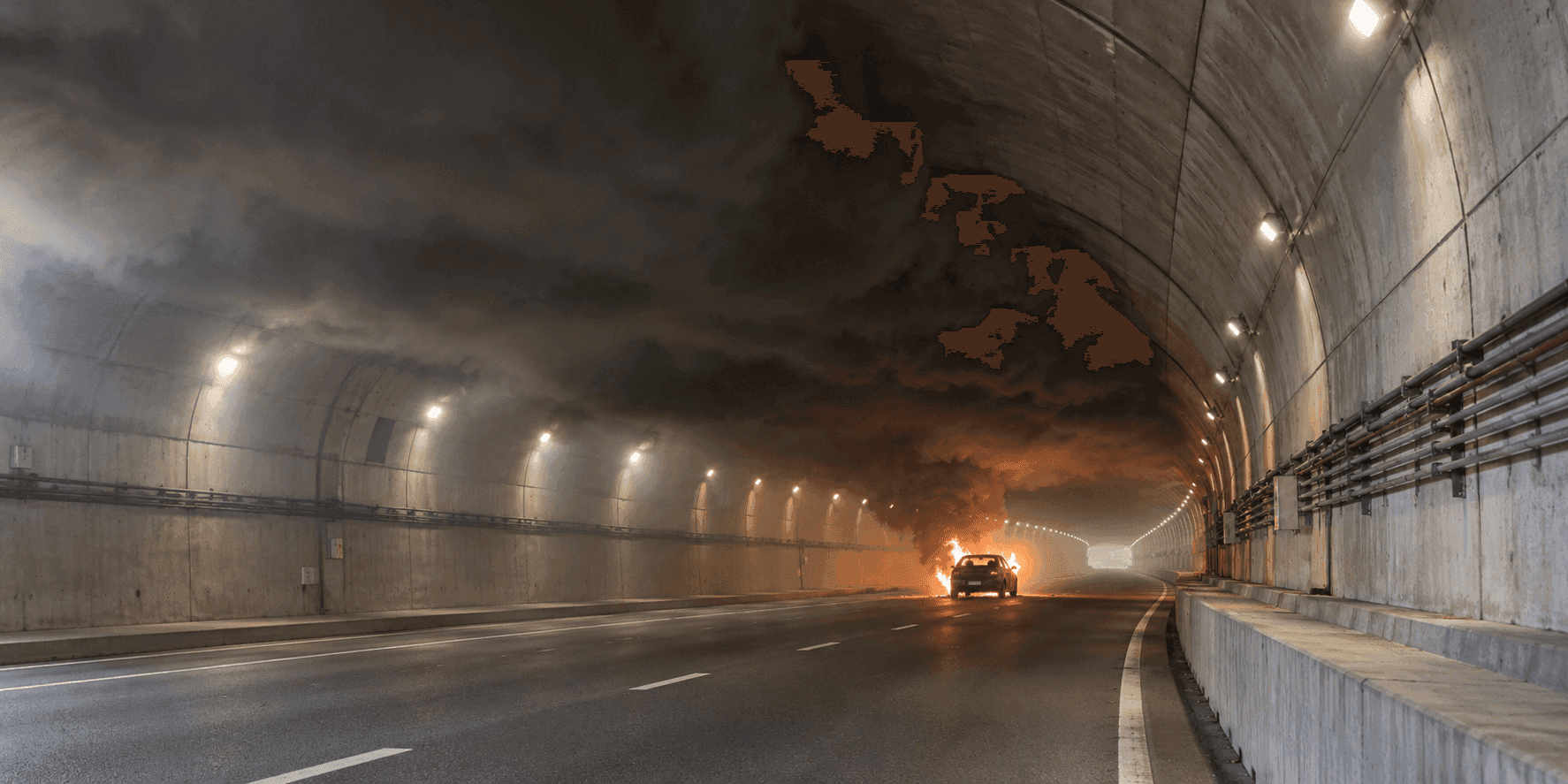
A burning vehicle in a tunnel creates a design problem that extends well beyond the fire location. Smoke can travel along the bore, people may need to pass stationary traffic to reach an exit, and emergency systems may depend on cables exposed within the same confined route.
Buildings also present complex fire conditions. Tunnels, however, combine elongated geometry, constrained access and strong interactions between fire and airflow.
These characteristics influence the fire scenario, evacuation strategy and performance required from passive protection.
Geometry Shapes the Exposure
A tunnel channels smoke and hot gases along a relatively narrow enclosure. Ceiling height, cross-section, gradient and the position of the fire influence how heat and smoke spread.
Nearby vehicles or equipment can obstruct airflow and alter local conditions. Portals, shafts and cross-passages introduce further pathways that need consideration.
PIARC identifies tunnel geometry, traffic, fire size and ventilation conditions as interacting factors in the development of a road-tunnel fire.
For engineers, this means a fire location cannot be assessed independently of the surrounding tunnel. The same fuel load may produce different consequences in different configurations.
Ventilation Changes Where Smoke Travels
Hot smoke rises and spreads beneath the tunnel crown. Longitudinal airflow can drive it predominantly in one direction, but smoke may also travel upstream against that flow. This is known as backlayering.
Ventilation therefore influences which areas become exposed and which evacuation routes remain usable. Moving smoke away from one group of occupants may direct it towards another occupied section.
The appropriate operating strategy depends on traffic direction, congestion, fire location and available exits. Airflow should be assessed through the project’s smoke-control strategy.
Passive protection needs to support that strategy, including the continued availability of relevant ducts, equipment and power or control routes.
Define the Fire Before Selecting a Curve
A tunnel fire assessment needs assumptions about fuel, growth rate, peak heat release rate, duration and location.
Road traffic, rail vehicles and service installations introduce different potential fire loads. A passenger-car scenario should not automatically represent heavy goods traffic, and road-tunnel assumptions should not be transferred directly to a metro tunnel.
Distinguish the design fire used for smoke and evacuation analysis from the temperature–time exposure used to assess structural protection. They serve related purposes but are not interchangeable.
The specification for tunnel fire protection systems should explain how each assessment connects to the project’s hazards and performance objectives.
Evacuation Depends on More Than Fire Resistance
A structurally intact tunnel can still contain conditions unsuitable for escape. Visibility, temperature, radiation and toxic gases influence whether occupants can reach a place of relative safety.
Assess the time needed to recognise the incident, leave a vehicle or train and travel to a protected route. Consider congestion, reduced mobility and the availability of exits.
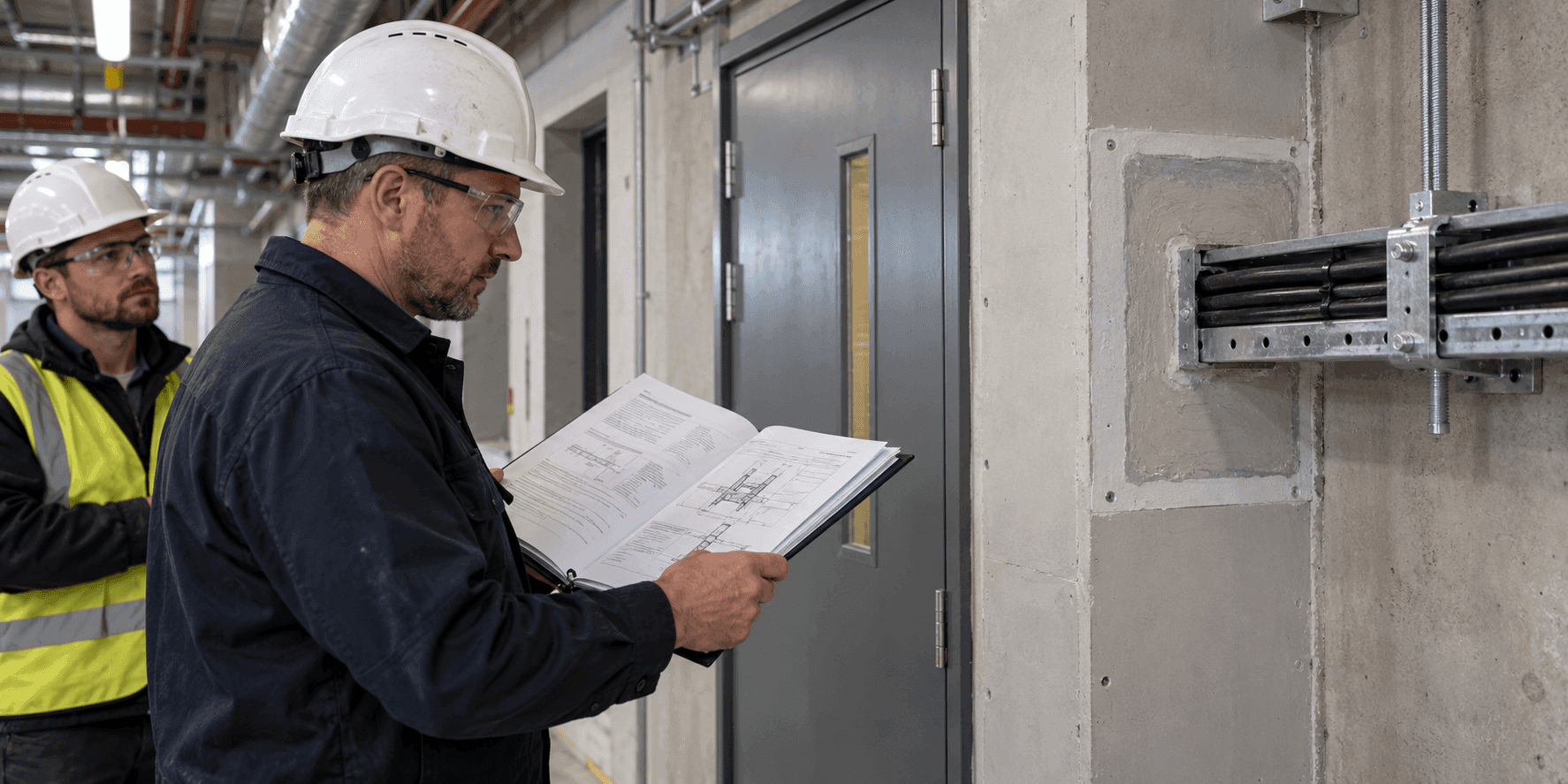
Cross-passage doors and separating walls can support evacuation, but their performance depends on complete assemblies and interfaces. Fire resistance alone does not establish smoke leakage performance, opening forces under pressure or reliable self-closing.
Those requirements need to be coordinated with ventilation and evacuation design.
Protect the Structure and Its Connections
Structural protection may be required to limit heating of concrete, reinforcement or structural steel and reduce the risk of unacceptable damage or instability.
The assessment should consider the relevant exposure, loading and material behaviour. Where required by the design basis, it should also address the cooling phase.
Panels or linings depend on anchors, joints and the supporting substrate. Assess these components as part of the protection arrangement, including overhead installation and interfaces at changes in geometry.
A material’s non-combustibility does not establish the fire resistance of the installed lining.
Preserve Essential Services
Emergency lighting, communications, detection and ventilation may share routes exposed to the incident.
A fire-rated cable protection system needs evidence appropriate to the required circuit function, including joints, supports and terminations. An intact enclosure does not automatically prove that every enclosed circuit remains operational.
Similarly, a fire-rated enclosure for electrical equipment should be assessed against equipment temperature limits and operating requirements.
Locate vulnerable connections and dependencies early. Protecting a main route while leaving a critical branch exposed can undermine the intended function.
Design for the Tunnel in Service
Water ingress, washing, corrosion, vibration and maintenance interventions can affect protection over time. Inspection access and repair procedures belong in the design.
Record approved details for penetrations, removable sections and replacement components. Later changes to traffic, rolling stock, ventilation or services may require reassessment.
Tunnel fire protection works through coordination: the fire scenario, smoke strategy, escape arrangements, structural protection and essential services must support the same safety objectives.