
What Is Passive Fire Protection and Where Is It Used?
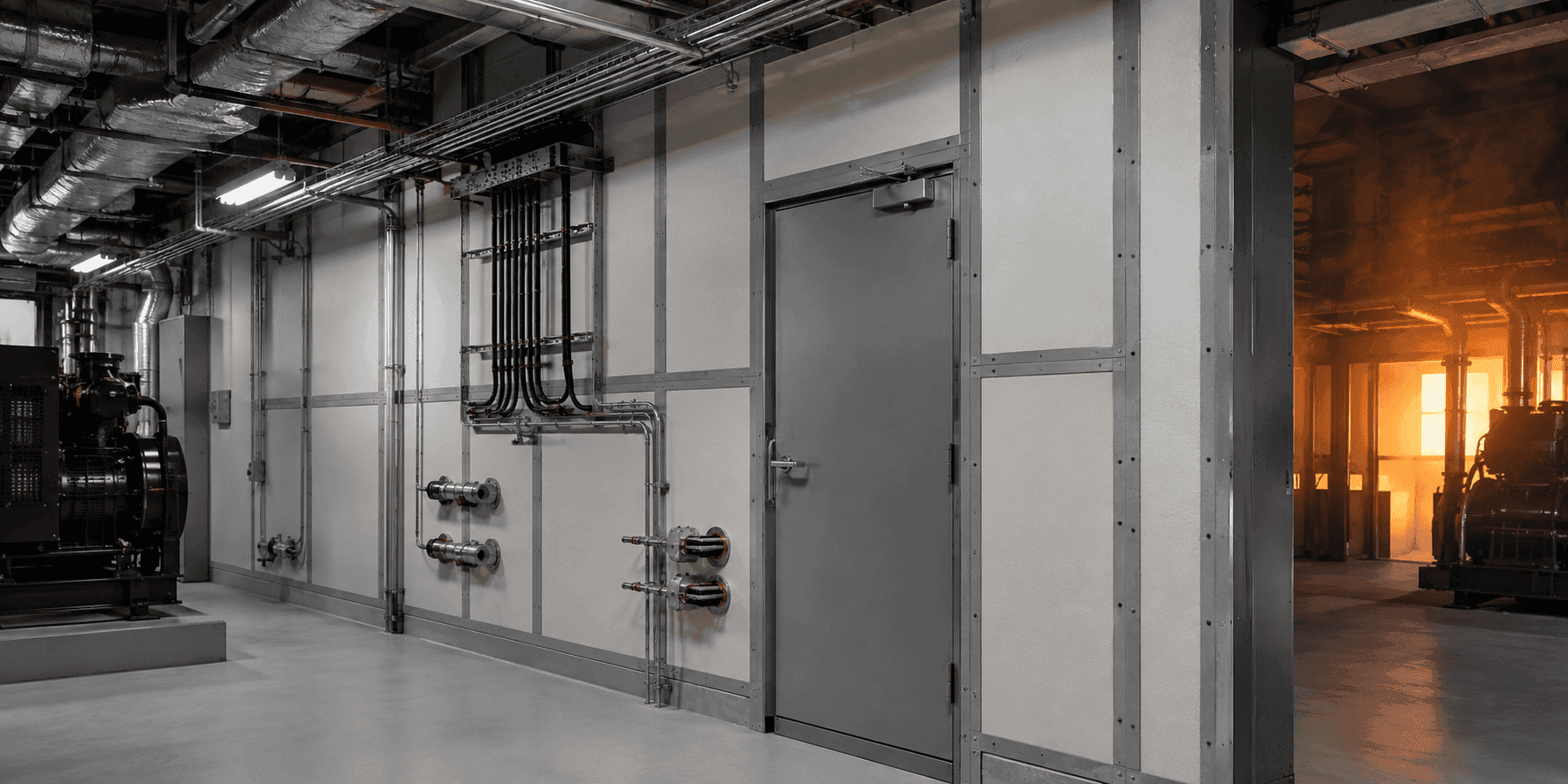
Passive fire protection uses built-in construction and protective systems to help resist fire, limit spread and protect defined routes, structures or assets. It works without needing a detection signal to provide its intended passive function.
What Is Passive Fire Protection?
Passive fire protection is the part of a fire strategy formed by built-in materials, elements and systems designed to provide defined fire-resistance, compartmentation or structural-protection functions. Examples can include fire-rated walls, floors, ceilings, doors, ducts, service-penetration systems, enclosures and protective linings.
The word passive does not mean maintenance-free. The system must be correctly selected, installed, inspected and protected from unreviewed changes. Its performance depends on the complete assembly, including joints, supports, fixings, penetrations, openings and adjoining construction.
Passive and active fire protection have different roles. Detection, alarms, suppression and smoke-control equipment may respond to a fire, while passive measures provide physical separation or protection. A coordinated fire strategy can require both.
- Compartmentation: Walls, floors, ceilings, doors and penetration systems help maintain defined fire-resisting boundaries.
- Structural protection: Systems may protect structural elements against specified fire exposure where the design requires it.
- Protected routes and spaces: Fire-resisting construction can support escape, intervention and separation of critical areas.
- Service protection: Ducts, cables and equipment enclosures may require protection appropriate to their function and fire strategy.
- Continuity at interfaces: Joints, openings, supports and adjoining elements must be coordinated as part of the assembly.
Passive and Active Fire Protection Roles
- Operation: Built into the asset and intended to perform without activation. Responds through detection, control or manual/automatic activation.
- Examples: Barriers, doors, ducts, penetration seals and structural protection. Alarms, detectors, sprinklers and other suppression or control systems.
- Dependency: Depends on assembly continuity and condition. Depends on power, water, controls, devices or human action as applicable.
- Inspection: Checks physical condition, alterations and interfaces. Includes functional testing, servicing and system readiness.
- Strategy: Limits spread or protects defined elements. Detects, warns, suppresses or manages fire effects.
Where Is Passive Fire Protection Used?
Applications depend on the building or asset fire strategy, hazards, occupancy, layout and applicable project requirements.
- Buildings and occupied facilities: Compartment boundaries, doors, service routes and protected areas can form part of life-safety planning.
- Industrial and energy assets: Separation may be required around equipment, process areas, electrical systems and occupied spaces.
- Tunnels and transport infrastructure: Protective systems can support structural, compartmentation, evacuation or service-continuity objectives.
- Data and critical facilities: Fire-resistant rooms, enclosures and service protection can support separation of essential assets.
- Existing facilities: Retrofit measures may address changed use, new services, damage or gaps identified through inspection.
What Can Compromise Passive Fire Protection?
A fire-rated product does not protect a boundary if the installed system is incomplete, damaged or altered outside its evidence.
- Unsealed penetrations: New cables, pipes or ducts create openings that are not protected by an appropriate system.
- Damaged barriers or doors: Impact, wear, corrosion or unauthorised work can weaken continuity.
- Incorrect components: Substituted fixings, seals or accessories may not match the approved assembly.
- Uncoordinated movement: Deflection and movement at joints can affect the fire-resisting boundary.
- Poor records: Teams cannot verify the installed arrangement or assess later changes confidently.
Why Passive Fire Protection Matters
Its contribution must be understood within the complete fire strategy and the tested or assessed system configuration.
- Limits fire spread: Compartmentation can help contain fire within defined boundaries.
- Supports evacuation and response: Protected routes and separation can provide time for planned actions.
- Protects critical assets: Enclosures and barriers can reduce exposure of selected equipment or spaces.
- Supports continuity planning: Containment can help reduce escalation and the extent of disruption.
What Should Be Checked When Selecting a System?
Selection should begin with the fire strategy and required function, not a material name alone.
- What fire exposure and criteria apply?: Confirm the required function, duration and classification basis.
- Does evidence match the arrangement?: Review dimensions, orientation, supports, joints, openings and limitations.
- How will interfaces be detailed?: Coordinate doors, ducts, cables, movement joints and adjoining construction.
- Who will install and inspect it?: Define competence, hold points, records and remedial responsibilities.
- How will later changes be controlled?: Establish inspection and permit processes for modifications.
How Invicta ANARA Supports Systems-Level Infrastructure Delivery
SECURA by Invicta ANARA addresses relevant critical containment and protection requirements, including passive fire-protection applications. Recommendations remain subject to the fire strategy, complete system configuration, available evidence and project-specific technical review.
SECURA by Invicta ANARA. Explore critical containment and protection systems for relevant project risks.
Fire protection systems. Review Invicta ANARA fire protection capabilities and related system applications.
Industrial fire compartmentation walls. Explore compartmentation walls planned around the complete boundary and project-specific requirements.
Frequently Asked Questions
Direct answers to common questions about passive fire protection.
What is passive fire protection?
It is built-in fire-resisting construction or protection intended to support compartmentation, structural protection or other defined fire-strategy functions.
Does passive fire protection need activation?
Its passive function does not normally depend on a detection signal, although associated doors, shutters or curtains may include active mechanisms.
Is passive fire protection maintenance-free?
No. It requires inspection, damage control, records and review of alterations throughout the asset lifecycle.
Where is passive fire protection required?
Requirements depend on the asset, fire strategy, applicable regulations, hazards and project design.
Why does the complete assembly matter?
Because joints, fixings, supports, openings and adjoining construction influence the performance of the installed boundary.
Share the fire strategy, system boundary and interface schedule so relevant passive fire-protection requirements can be reviewed. Discuss an Infrastructure Requirement.