
What Does a Fire-Resistance Rating Actually Mean?
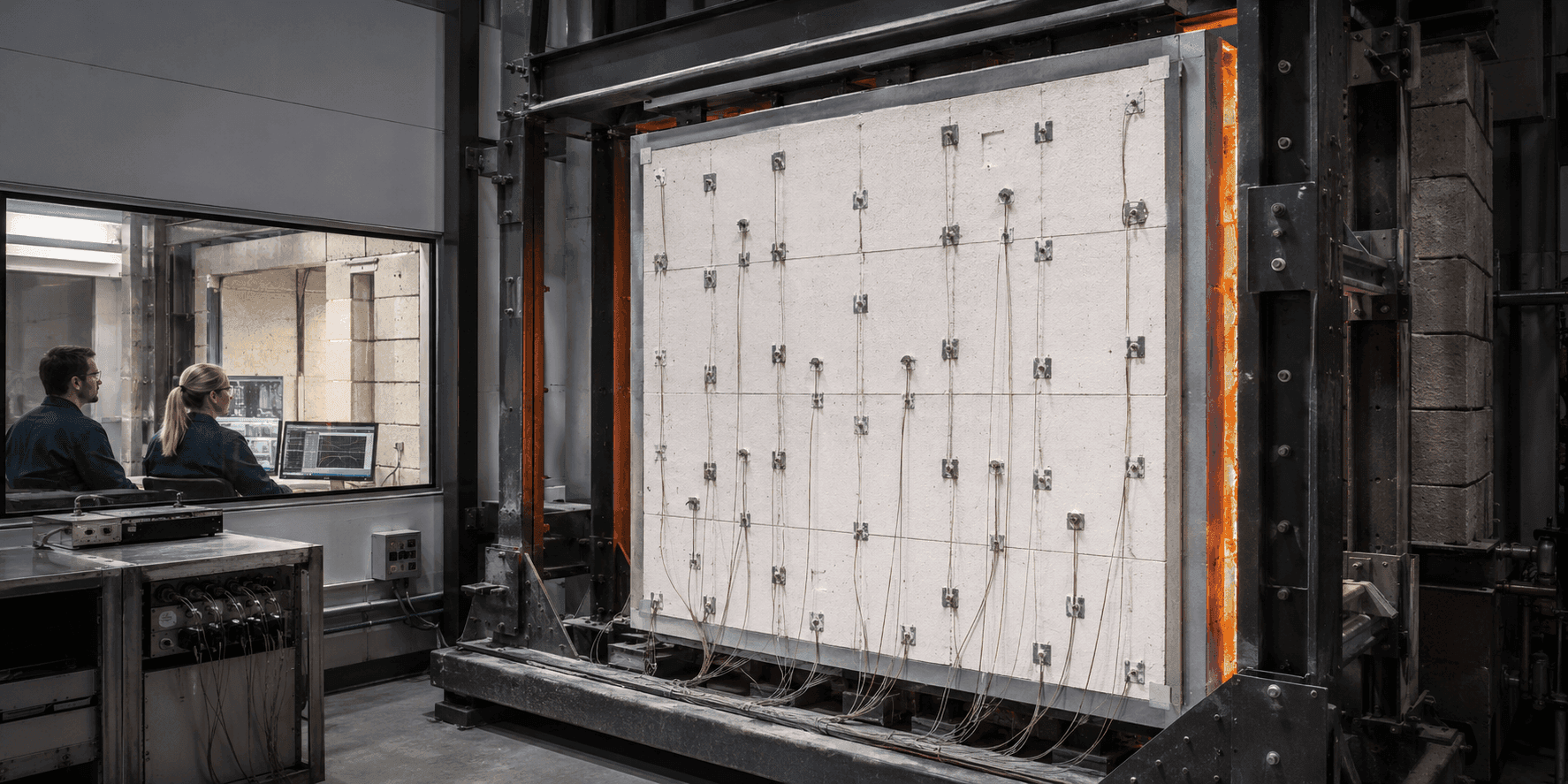
A fire resistance rating describes how a tested or assessed system performed against defined criteria for a stated duration under specified conditions. It applies to the complete configuration—not automatically to every use of one material.
What Is a Fire Resistance Rating?
A fire resistance rating expresses the period for which an element or system satisfied stated performance criteria during a recognised test or classification process. Depending on the element and method, the criteria can address loadbearing capacity, integrity, insulation or other defined functions.
The duration is not a prediction that every real fire will behave identically or that the system will remain unaffected until a precise minute. It is a classification derived from controlled exposure and the tested arrangement. The result must therefore be read together with the supporting evidence.
Dimensions, orientation, exposure direction, supports, joints, fixings, openings, penetrations and substrates can all define the permitted application. A rating should never be separated from these boundaries when specifying or approving an installed system.
- Duration: The stated period for which the specimen met the applicable criteria during the defined test.
- Integrity: The ability to resist passage of flames and hot gases under the applicable classification method.
- Insulation: The ability to limit temperature rise on the unexposed face where this criterion applies.
- Loadbearing capacity: The ability of a structural element to sustain the required load during exposure where relevant.
- Test configuration: The complete specimen, supports, joints, fixings, dimensions and exposure arrangement.
- Field of application: The changes or ranges permitted by the evidence without unsupported extrapolation.
What a Rating Tells You—and What It Does Not
- Duration: How long stated criteria were achieved in the defined assessment. A guarantee of identical performance in every possible fire.
- System: Performance of the tested or assessed assembly. A universal property of one board, panel or material.
- Configuration: Evidence for stated dimensions, orientation and details. Permission to alter supports, joints or openings without review.
- Criteria: The functions specifically included in the classification. Proof of unrelated blast, impact, smoke or structural performance.
- Application: A basis for project selection when conditions align. A substitute for fire strategy and engineering coordination.
How to Read Fire-Resistance Evidence
The headline rating is only the entry point. Project teams should review the evidence package and compare it with the proposed arrangement.
- Identify the element: Confirm whether the evidence covers a wall, floor, ceiling, door, duct, structural element or enclosure.
- Check the criteria: Verify which functions were assessed and how they are expressed.
- Review exposure and orientation: Confirm the fire side, horizontal or vertical use and any directional limitations.
- Compare dimensions and supports: Check spans, heights, framing, substrates, fixings and restraint conditions.
- Coordinate openings and joints: Confirm permitted penetrations, doors, movement joints and edge details.
- Record project deviations: Refer changes outside the evidence for competent technical review.
Common Misinterpretations of Fire Ratings
Most errors occur when a classification is reduced to one number and separated from the system it describes.
- Material equals system: A component's properties are assumed to establish the rating of the complete assembly.
- Longer always means suitable: A higher duration is selected without checking criteria, configuration or fire strategy.
- Any opening is acceptable: Doors, ducts or services are added without evidence for their interfaces.
- Orientation is ignored: Evidence for one direction or support condition is used in another.
- Site changes are treated as minor: Substitutions and revised fixings are installed without assessing their effect.
Why Correct Interpretation Matters
Reading ratings accurately supports defensible specification, procurement and inspection decisions.
- Better system selection: The proposed arrangement is compared with relevant evidence.
- Clearer interface design: Openings, supports and adjoining construction are addressed early.
- More useful inspection: Inspectors know which details and limitations must be verified.
- Controlled change: Departures from the evidence are visible and reviewed before installation.
Questions to Ask Before Accepting a Fire Rating
Approval should be based on the evidence and proposed configuration, not the rating label alone.
- Which system was tested?: Request the complete assembly description and relevant reports or classifications.
- Which criteria were achieved?: Confirm duration and the specific performance functions included.
- Do project dimensions fall within scope?: Check height, width, span, orientation and support limits.
- How are interfaces treated?: Review doors, penetrations, joints, edges and adjoining elements.
- Who reviews deviations?: Define the competent approval route for changes outside documented scope.
How Invicta ANARA Supports Systems-Level Infrastructure Delivery
SECURA by Invicta ANARA supports relevant fire-protection and containment requirements using system-specific selection and project coordination. Any stated fire-resistance capability remains subject to the complete configuration, applicable evidence and project requirements.
SECURA by Invicta ANARA. Explore critical containment and protection systems for relevant fire and infrastructure risks.
Fire protection systems. Review Invicta ANARA fire-protection capabilities and related applications.
Industrial fire compartmentation walls. Explore compartmentation walls planned around complete assemblies and project interfaces.
Frequently Asked Questions
Direct answers to common questions about fire resistance rating.
What does a fire resistance rating mean?
It states how long a tested or assessed system met defined criteria under specified exposure and configuration conditions.
Does a 120-minute rating mean the system fails at 121 minutes?
No. It records the achieved classification period under the test; it is not a precise prediction for every real event.
Is integrity the same as insulation?
No. Integrity addresses passage of flames and hot gases, while insulation addresses temperature rise where that criterion applies.
Can a rated material create a rated wall?
Not by itself. The complete wall assembly, including supports, joints, fixings and openings, requires relevant evidence.
Can test evidence be used for larger dimensions?
Only where the field of application or an appropriate assessment permits the proposed dimensions.
Share the required criteria, proposed configuration and interface schedule so the applicable fire-resistance evidence can be reviewed. Discuss an Infrastructure Requirement.