
How Fire-Rated Walls Maintain Compartment Integrity
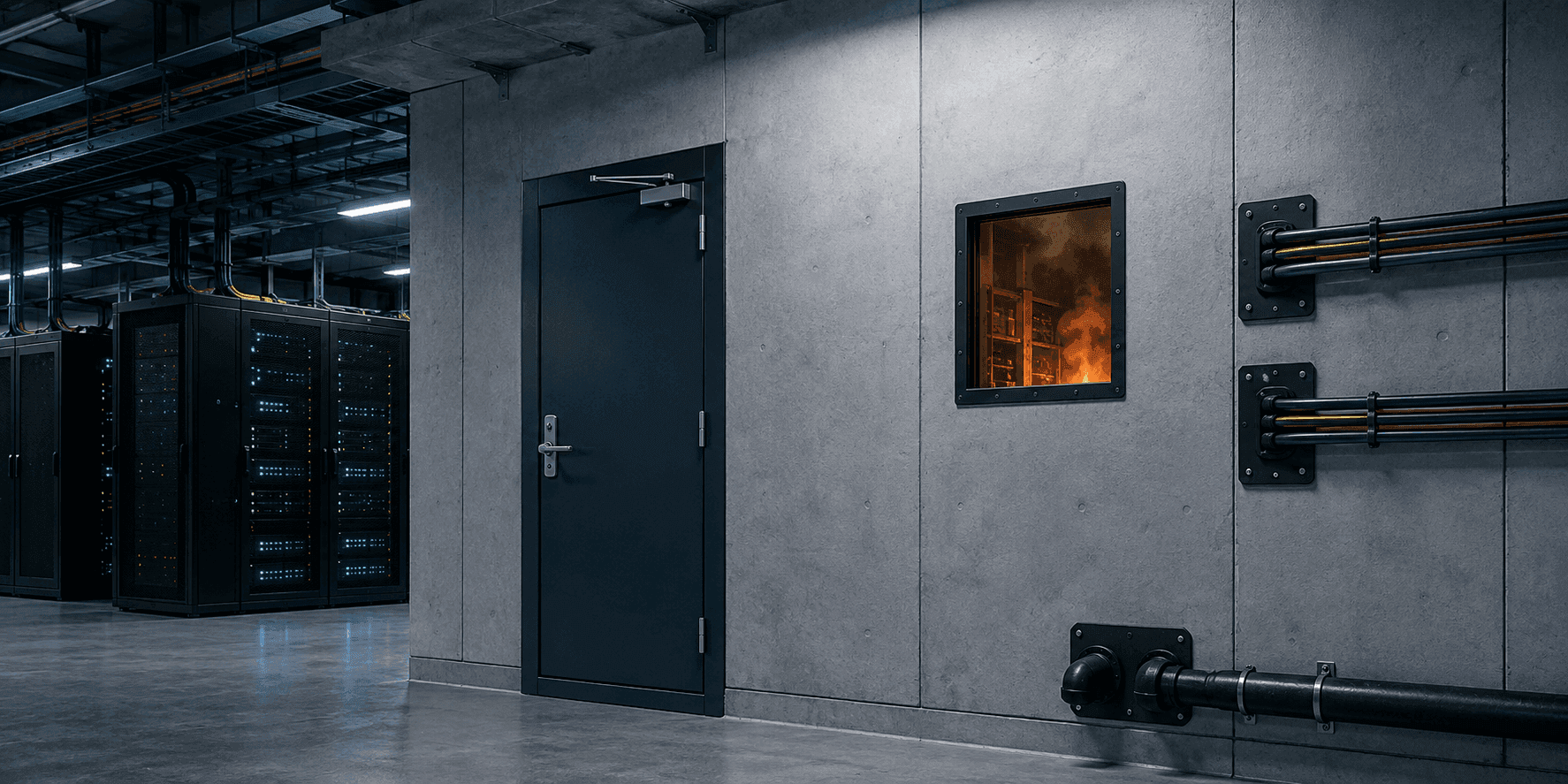
Fire-rated wall systems maintain compartment integrity when panels, framing, supports, fixings, joints, edges and protected openings function as one continuous assembly. The rating applies to the documented system, not the wall surface alone.
How Does a Fire-Rated Wall Maintain Integrity?
A fire-rated wall maintains compartment integrity by forming a continuous fire-resisting boundary between defined areas for the required criteria and duration. The visible panels or boards are only part of that boundary. Framing, fixings, joints, head details, base connections and interfaces with adjoining construction all influence performance.
During fire exposure, materials heat, expand, deflect and lose strength at different rates. The wall configuration must accommodate these effects within the arrangement represented by the applicable evidence. Unsupported changes in height, span, orientation, fixing pattern or substrate can alter behaviour.
Openings are critical. Doors, ducts, cable routes, pipes and access panels interrupt the wall and require compatible protection. Compartment integrity therefore depends on coordinated design, controlled installation, inspection and change management throughout the asset lifecycle.
- Protective faces: Boards, panels or layers resist the defined exposure as part of the qualified assembly.
- Framing and supports: Members, substrates and restraint maintain the wall geometry and transfer loads.
- Fixings: Type, spacing, edge distance and embedment retain components in their intended positions.
- Joints and edges: Seams, movement details and perimeter connections preserve continuity.
- Protected openings: Doors and service penetrations use suitable systems coordinated with the wall.
- Verified installation: Inspection confirms that the installed configuration and approved changes remain traceable.
Wall Component and Its Role in Compartment Integrity
- Panels or boards: Provide the protective layers in the tested arrangement. Risk if changed: thermal and structural behaviour may differ.
- Framing: Supports the wall and controls geometry. Risk if changed: span, restraint and deflection assumptions may be lost.
- Joints: Connect layers and accommodate defined movement. Risk if changed: gaps can form through the boundary.
- Head detail: Completes the wall at the structure above. Risk if changed: building movement can damage or open the interface.
- Penetrations: Allow services while maintaining required protection. Risk if changed: unsupported openings bypass the wall assembly.
- Doors: Provide controlled access through the compartment line. Risk if changed: the opening may no longer provide the required function.
How the Complete Wall Assembly Works
Compartment integrity is created by combined component behaviour from the supporting structure to every opening.
- Define the boundary: Set the wall line, height, exposure direction and required performance criteria.
- Coordinate the support: Check substrate, loads, tolerances, movement and connection details.
- Configure the wall: Select layers, framing, fixings, joints and edge conditions within applicable evidence.
- Plan openings: Identify doors and services early so compatible systems can be integrated.
- Control installation: Use approved drawings, hold points and technical review for site constraints.
- Maintain continuity: Inspect damage and later alterations and update the asset record.
Where Fire-Rated Walls Commonly Lose Integrity
Weaknesses are often found at edges, openings and changes rather than across the main wall surface.
- Incomplete wall head: The wall stops short of the structure or uses an unsuitable movement detail.
- Unqualified penetration: Services pass through the assembly without an appropriate opening system.
- Changed fixing pattern: Fixing type or spacing differs from approved construction.
- Unsupported height or span: Dimensions exceed the documented field of application.
- Impact or moisture damage: Operational exposure compromises layers, joints or framing.
- Uncontrolled retrofit: New access, equipment or services alter the boundary without review.
What a Continuous Fire-Rated Wall Supports
A properly selected and maintained assembly contributes to the wider compartmentation and fire strategy.
- Defined separation: The wall helps limit fire and hot-gas spread between designated areas.
- Coordinated openings: Access and services are planned as part of the complete boundary.
- Inspectable construction: Approved details provide a basis for site verification.
- Controlled lifecycle: Records support maintenance and future modification decisions.
What Should Be Verified Before Wall Approval?
Approval should connect the specified wall, supporting evidence and actual project arrangement.
- Which criteria and duration apply?: Confirm the fire-strategy requirement and applicable exposure.
- Does the assembly match evidence?: Review layers, framing, fixings, joints, supports and orientation.
- Are dimensions permitted?: Check height, width, span and restraint limitations.
- How are openings protected?: Coordinate doors, ducts, cables, pipes and access panels.
- How will changes be recorded?: Define inspection, technical queries, deviations and final asset information.
How Invicta ANARA Supports Systems-Level Infrastructure Delivery
SECURA by Invicta ANARA supports relevant cellulosic fire-protection and compartmentation wall requirements. System selection and any stated performance remain subject to the complete configuration, applicable evidence, supporting construction and project review.
SECURA by Invicta ANARA. Explore critical containment and protection systems for relevant fire and infrastructure risks.
Cellulosic fire protection. Review Invicta ANARA systems for relevant cellulosic-fire requirements and applications.
Industrial fire compartmentation walls. Explore compartmentation walls planned around complete assemblies and project interfaces.
Frequently Asked Questions
Direct answers to common questions about fire rated wall systems.
How does a fire-rated wall maintain compartment integrity?
It uses a continuous, evidence-supported assembly of layers, framing, fixings, joints, supports and protected openings.
Is the wall panel itself fire rated?
A panel may have relevant properties, but the fire-resistance classification applies to the complete tested or assessed wall system.
Why does deflection matter?
Movement of the wall or supporting structure can open joints or damage connections unless suitable details are coordinated.
Can services pass through a fire-rated wall?
Yes, when each opening uses an appropriate system supported for the wall, service type and required performance.
When should the wall be reinspected?
Inspect after damage, service work, refurbishment, change of use or other alterations, and at intervals set by the asset's maintenance plan.
Share the required wall rating, dimensions, supports and opening schedule so the complete compartmentation configuration can be reviewed. Discuss an Infrastructure Requirement.