
Fire Protection, Fireproofing and Fire Stopping: How Do They Differ?
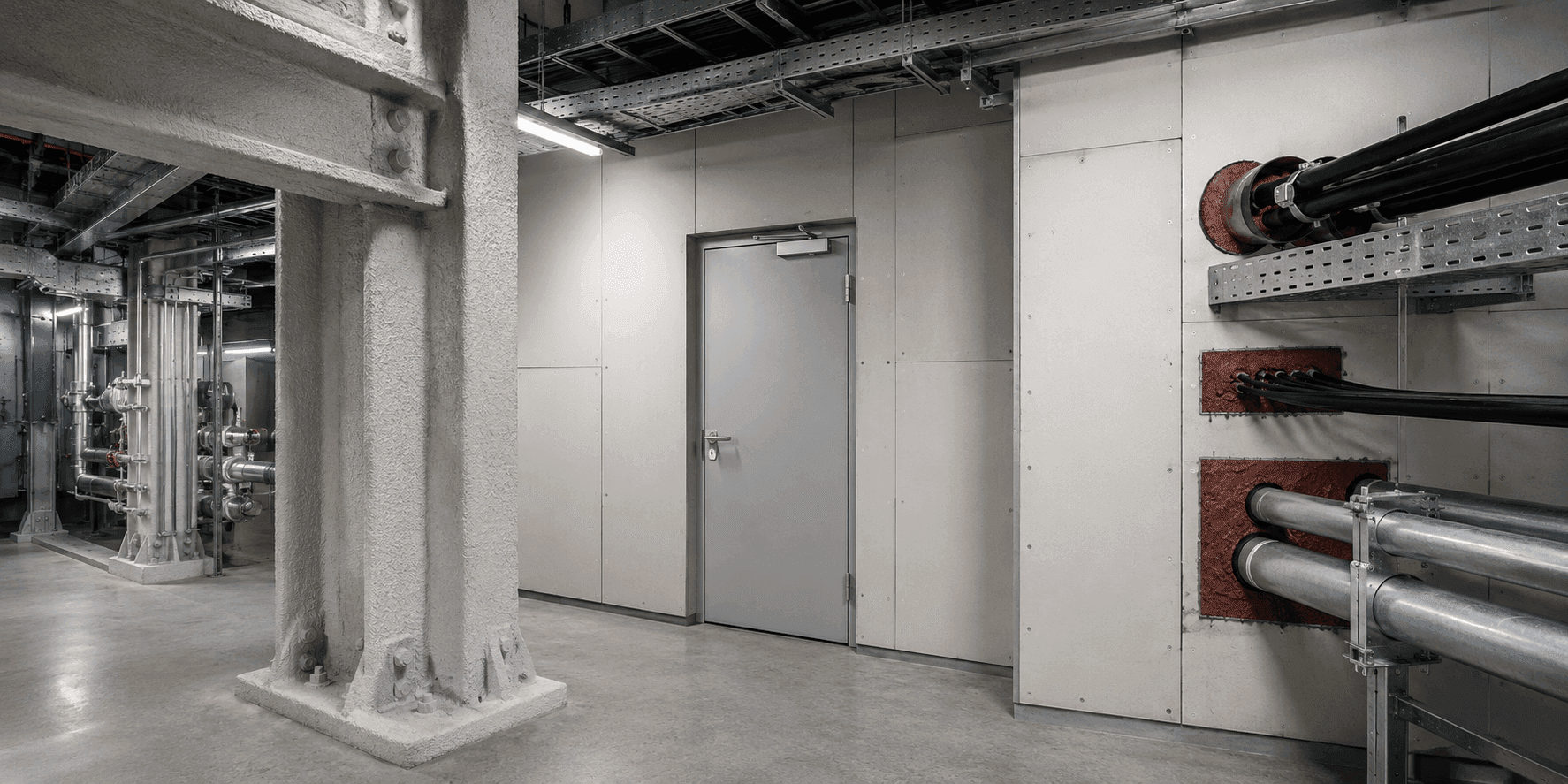
Fire protection is the broad strategy and system category. Fireproofing commonly refers to protecting materials or structural elements against fire exposure. Fire stopping seals service openings and joints in fire-resisting construction.
What Do Fire Protection, Fireproofing and Fire Stopping Mean?
Fire protection is the broadest term. It covers active and passive measures used to detect, warn, suppress, contain or resist fire and protect people, structures, services or assets.
Fireproofing is an industry term often used for systems applied to structural steel, concrete or other elements to achieve a required fire-resistance function. The word can be misleading because it may suggest absolute immunity from fire. Technical documents should state the actual tested or assessed performance and configuration.
Fire stopping is more specific. It addresses penetrations and joints in fire-resisting walls or floors so that services, gaps and movement details do not leave an unprotected route through the compartment boundary. A firestop product must be used as part of an appropriate system for the opening, service, substrate and required performance.
- Fire protection: The overall family of active and passive strategies and systems.
- Fireproofing: Protection applied or installed to help an element meet defined fire-resistance requirements.
- Fire stopping: Systems for service penetrations and joints within fire-resisting boundaries.
- Compartmentation: The wider walls, floors, doors and interfaces that form the boundary.
- Evidence: Each term must be connected to the actual system configuration and required criteria.
How the Three Terms Differ
- Scope: Fire protection covers the overall strategy. Fireproofing and fire stopping address narrower applications.
- Typical location: Across the asset wherever the fire strategy requires measures. Fireproofing protects elements; fire stopping treats openings and joints.
- Selection basis: Hazards, strategy, occupancy, asset and applicable requirements. Specific element, opening, substrate, service and evidence.
- Responsible parties: Several designers, contractors and specialists may contribute. Responsibility should be assigned for each element and interface.
- Main risk: Assuming one measure completes the whole strategy. Using a product outside the tested or assessed arrangement.
Where Each System Fits
Clear terminology helps specifications assign the right function to the right system and trade.
- Structural elements: Fireproofing or protective boards may be selected where the structure requires a defined fire-resistance function.
- Compartment walls and floors: Fire-resisting construction establishes the primary boundary between defined areas.
- Pipes and cables: Fire-stopping systems address the particular service and opening through the boundary.
- Movement joints: Joint systems must accommodate the specified movement while supporting the required fire function.
- Doors and ducts: Dedicated assemblies and interfaces maintain openings needed for access and services.
Specification Risks Caused by Unclear Terminology
Broad words can hide missing scope, incompatible systems or responsibility gaps.
- Calling everything fireproof: The specification does not state the required criteria, duration or limitations.
- Treating fire stopping as filler: A generic sealant is selected without matching the service, opening and substrate.
- Ignoring the supporting element: A protection system is specified without confirming substrate, fixings or movement.
- Splitting responsibility: Different trades leave gaps at wall, service and door interfaces.
- Failing to record changes: New penetrations and substitutions are not assessed against the approved system.
Benefits of Precise Fire-Protection Language
Clear terms improve design coordination, procurement, inspection and future change control.
- Better specifications: Functions and evidence are assigned to defined elements.
- Clearer trade scope: Each opening, joint and protective system has an owner.
- More reliable inspection: Inspectors can compare the installation with the relevant system details.
- Safer alterations: Future teams can identify how new services affect the compartment.
What Should a Specification State?
The specification should describe required performance and configuration rather than relying on broad labels.
- What is being protected?: Identify the structure, compartment, service, opening or asset.
- Which criteria apply?: State the required fire-resistance function and project basis.
- What arrangement is permitted?: Define substrate, size, orientation, supports, services and limitations.
- Who owns the interfaces?: Assign design, installation, inspection and remedial responsibilities.
- What records are required?: Set drawings, product/system identification, inspection and change documentation.
How Invicta ANARA Supports Systems-Level Infrastructure Delivery
SECURA by Invicta ANARA supports relevant fire-protection and containment applications. System selection should remain tied to the fire strategy, complete assembly, supporting evidence and project-specific interfaces rather than broad terminology alone.
SECURA by Invicta ANARA. Explore critical containment and protection systems for relevant project risks.
Fire protection systems. Review Invicta ANARA fire protection capabilities and related system applications.
Industrial fire compartmentation walls. Explore compartmentation walls planned around the complete boundary and project-specific requirements.
Frequently Asked Questions
Direct answers to common questions about fire protection vs fireproofing vs fire stopping.
Is fireproofing the same as fire protection?
No. Fire protection is the broader field. Fireproofing commonly describes protection for particular materials or structural elements.
What is fire stopping used for?
It protects service penetrations and joints in fire-resisting walls or floors using a system appropriate to the opening and services.
Can ordinary sealant be used as fire stopping?
Only when it forms part of suitable evidence for the specific application. A generic sealant should not be assumed to provide fire resistance.
Why can the term fireproof be misleading?
It can imply absolute protection. Technical specifications should state defined fire-resistance performance and limitations.
Who is responsible for fire stopping?
The contract should assign design, installation, inspection and change responsibilities across the relevant trades.
Share the fire strategy, element schedule and service-interface details so the appropriate protection scope can be reviewed. Discuss an Infrastructure Requirement.