
Common Passive Fire Protection Failures Found During Inspection
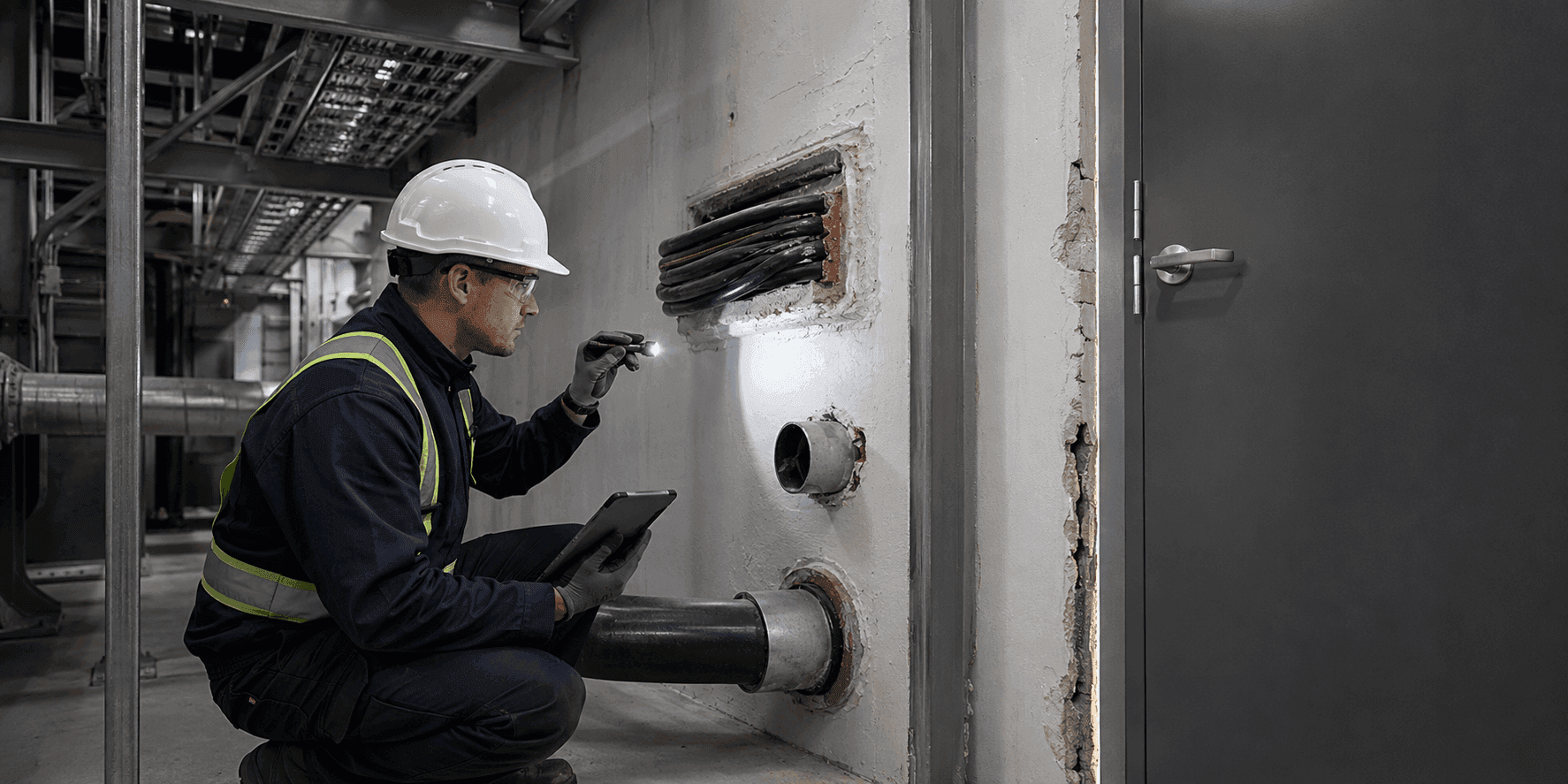
Common passive fire protection failures include unprotected service penetrations, damaged seals, altered doors, incomplete barriers, unsuitable substitutions and missing records. Each defect should be assessed against the intended compartment and system evidence.
What Passive Fire Protection Failures Are Commonly Found?
Inspection failures often occur at interfaces or after the original construction has been altered. New cables and pipes may pass through fire-resisting walls without suitable protection. Doors can be damaged, wedged open or modified. Barriers may stop above ceilings without the required continuation.
Other defects are less visible. Fixing spacing may differ from the approved detail, joint materials may be incomplete, labels may be missing, or services may be tightly grouped in an arrangement not represented by the selected penetration system.
The response should not be a generic patch. Inspectors should identify the intended boundary, determine the installed system where possible and assess the defect against relevant evidence. Remedial work then needs controlled design, installation, inspection and records.
- Unprotected penetrations: Cables, pipes or ducts cross a boundary without an appropriate system.
- Damaged seals: Existing penetration or joint systems are cracked, displaced, incomplete or affected by later work.
- Altered fire doors: Leaves, frames, seals, closers, glazing or hardware no longer match the required assembly.
- Barrier discontinuities: Walls, ceilings or cavity barriers do not connect continuously to adjoining construction.
- Unsupported substitutions: Different boards, fixings, seals or accessories have been installed without review.
- Poor identification: Labels, location records or system details are missing, limiting verification and maintenance.
Inspection Finding, Risk and Required Response
- Open service hole: Creates a direct breach through the boundary. Identify services and install an appropriate reviewed penetration system.
- Damaged fire door: Can compromise the protected opening. Assess the complete door assembly and repair or replace appropriately.
- Incomplete wall head: Leaves discontinuity at the structural interface. Review movement and head details before remediation.
- Unknown seal: Performance and permitted application cannot be confirmed. Investigate records and obtain competent assessment.
- Missing records: Future changes and inspections cannot verify the system. Reconstruct an asset register with suitable evidence and locations.
A Structured Inspection Process
Inspection should follow the compartment strategy and distinguish observation from technical acceptance.
- Confirm the boundary: Use current drawings to identify walls, floors, ceilings, doors and concealed interfaces.
- Record the condition: Capture location, dimensions, services, materials, photographs and visible defects.
- Identify the system: Compare labels, records and installed details with the approved arrangement.
- Classify the finding: Prioritise defects according to boundary function, uncertainty and consequence.
- Design remediation: Select repairs that are supported for the actual substrate, opening and services.
- Verify close-out: Inspect completed work and update the asset record.
Why Quick Repairs Can Create Further Failures
Filling a visible gap does not necessarily restore the fire-resisting function.
- Wrong repair material: A sealant or board is used outside its supported application.
- Hidden depth or backing omitted: The visible surface looks complete but the required system build-up is missing.
- Mixed services ignored: Different cables, pipes or insulation types are treated as one generic penetration.
- Movement not addressed: A rigid repair is used where the joint or structure must move.
- Records remain incomplete: The repair cannot be identified or managed during later alterations.
What Effective Inspection and Remediation Achieve
A controlled programme restores confidence in the boundary and improves future asset management.
- Prioritised risk: Material defects and uncertainties are addressed systematically.
- Evidence-led repairs: Remediation is matched to the actual opening and assembly.
- Better change control: Future works can identify existing systems and approval needs.
- Stronger records: The asset owner gains a usable register for recurring inspection.
What Should a Passive Fire Inspection Report Include?
The report should provide enough context for technical review and controlled remediation.
- Exact location: Identify compartment, level, room, grid or asset reference.
- Boundary and system type: State the wall, floor, door, joint or penetration involved.
- Observed condition: Record dimensions, services, damage and visible construction.
- Evidence status: Note whether the installed system and permitted application are confirmed.
- Required action: Set assessment, repair, priority, verification and record updates.
How Invicta ANARA Supports Systems-Level Infrastructure Delivery
SECURA by Invicta ANARA supports relevant passive fire-protection and compartmentation requirements. Inspection findings and remedial recommendations should be reviewed against the complete system configuration, applicable evidence and asset-specific fire strategy.
SECURA by Invicta ANARA. Explore critical containment and protection systems for relevant fire and infrastructure risks.
Fire protection systems. Review Invicta ANARA fire-protection capabilities and related applications.
Industrial fire compartmentation walls. Explore compartmentation walls planned around complete assemblies and project interfaces.
Frequently Asked Questions
Direct answers to common questions about passive fire protection failures.
What are the most common passive fire protection failures?
Unsealed penetrations, damaged seals, altered doors, discontinuous barriers, unsupported substitutions and missing records are frequent findings.
Can every gap be repaired with fire-rated sealant?
No. The repair must suit the opening, services, substrate, dimensions and required performance.
Why do fire doors fail inspection?
Common reasons include damage, poor closure, altered hardware, missing seals, unsuitable gaps and changes to the frame or glazing.
What should happen after a defect is found?
Record it, assess its significance, design an appropriate repair, verify the work and update the asset register.
Are labels enough to prove compliance?
No. Labels help identification, but the complete installed arrangement and evidence must still be checked.
Share the compartment records, inspection findings and remedial scope so relevant passive fire-protection requirements can be reviewed. Discuss an Infrastructure Requirement.