
Cellulosic vs Hydrocarbon Fire: Why the Curve Changes the System
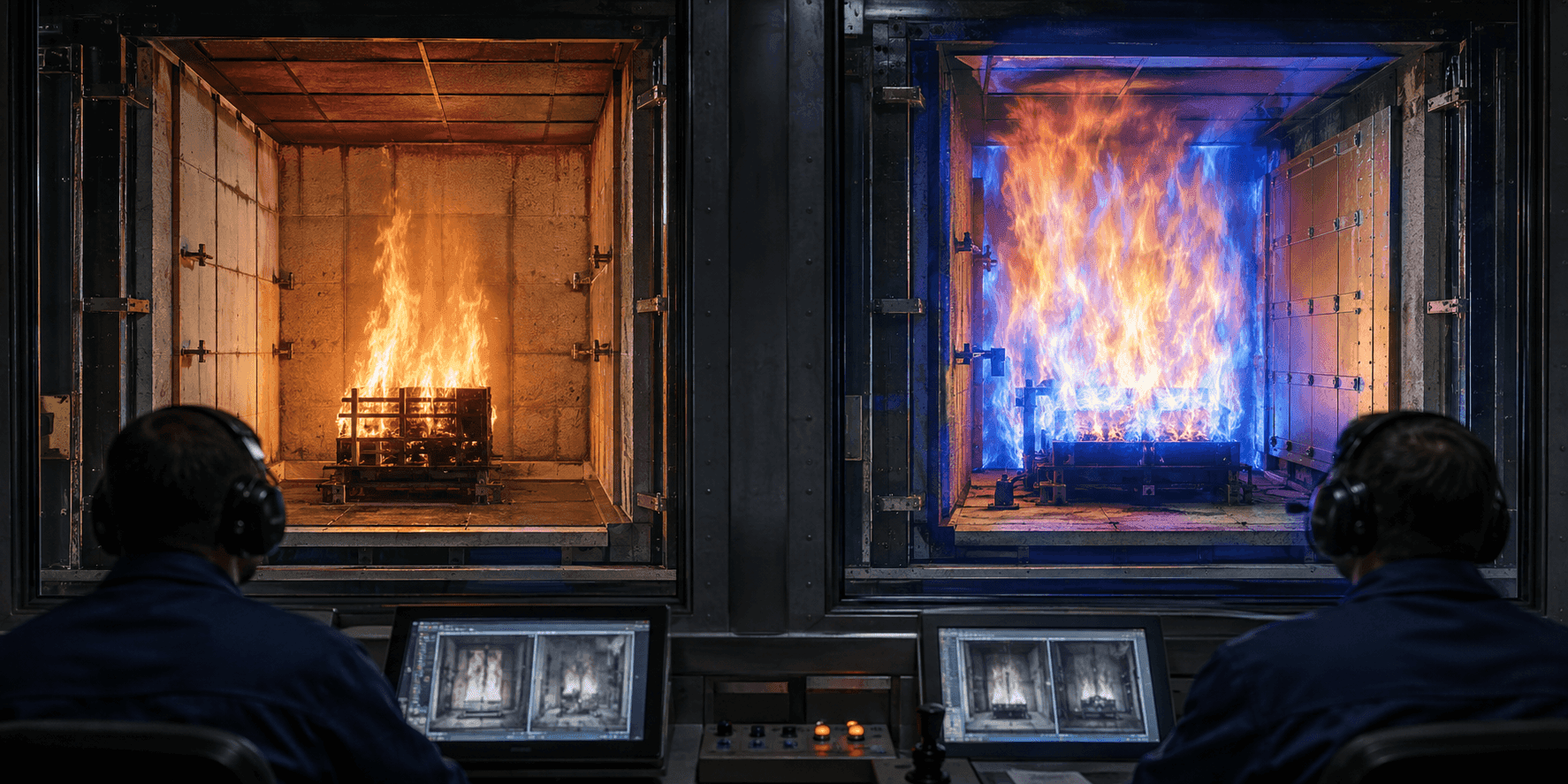
Cellulosic and hydrocarbon fire curves represent different standardised heating regimes. Hydrocarbon exposure rises more rapidly and reaches a severe temperature sooner, while cellulosic exposure develops differently. System evidence must match the specified curve.
How Do Cellulosic and Hydrocarbon Fire Curves Differ?
Cellulosic and hydrocarbon fire curves are controlled time-temperature exposures used for different fire-resistance contexts. The cellulosic curve is broadly associated with ordinary combustible building contents. Hydrocarbon curves are associated with hazards involving flammable liquids or gases and typically impose a more rapid initial temperature rise.
This distinction affects system testing and selection, but it should not be reduced to the idea that one curve is simply better or universally worse. A system qualified under one exposure cannot automatically be assumed to achieve the same classification under another. Materials, joints, fixings, supports and insulation can respond differently to the rate and severity of heating.
The governing exposure should follow the credible project hazard, fire strategy and applicable requirements. Some facilities contain more than one hazard zone, so separate parts of the asset may require different evidence.
- Fuel context: Cellulosic exposure relates broadly to ordinary combustibles; hydrocarbon exposure relates to flammable liquid or gas hazards.
- Heating rate: Hydrocarbon curves generally impose a faster early temperature rise than the standard cellulosic curve.
- System response: Rapid heating can change thermal movement, joint behaviour, fixing demand and insulation response.
- Typical context: Cellulosic evidence is common in buildings; hydrocarbon evidence is relevant to defined process, energy or transport hazards.
- Evidence boundary: A classification applies only to the curve, criteria and complete configuration represented.
- Hazard-led selection: The project fire strategy determines which exposure is relevant rather than the product label alone.
Cellulosic and Hydrocarbon Fire Exposure Compared
- Associated context: Ordinary combustible building contents and similar hazards. Flammable liquid or gas hazards in relevant industrial contexts.
- Initial heating: Develops according to the standard cellulosic relationship. Generally rises more rapidly during the early period.
- Evidence: Requires testing or assessment under the applicable cellulosic method. Requires evidence for the specified hydrocarbon exposure.
- Applications: Often used for buildings, rooms and compartment boundaries. Often relevant to defined energy, process or transport hazards.
- Selection: Use where the project fire scenario supports it. Use only where the hazard and fire strategy require it.
- Interchangeability: Cannot establish hydrocarbon performance by assumption. Does not automatically establish suitability for every other fire scenario.
Why the Fire Curve Can Change System Design
Different heating regimes can affect the components and interfaces that allow a fire-resisting system to function.
- Protective layer: Material type, thickness and arrangement must suit the qualified exposure.
- Joints and seams: Thermal movement and rapid heating place demands on continuity details.
- Fixings and framing: Retention and support behaviour must remain within the tested configuration.
- Substrate and restraint: Connections transfer movement and load into surrounding construction.
- Penetrations and openings: Doors, ducts, cables and pipes require evidence compatible with the boundary.
- Inspection criteria: Site verification must follow the approved curve-specific system details.
Common Oversimplifications to Avoid
Fire-curve terminology is useful only when it supports accurate hazard and evidence decisions.
- One duration fits all: The same number of minutes is treated as equivalent across different exposures.
- Sector-based assumption: A curve is selected only because a project belongs to a particular industry.
- Material substitution: A similar-looking product replaces a component in a qualified assembly.
- Mixed hazards ignored: Different rooms or assets are assigned one generic exposure without review.
- Configuration omitted: The specification names a curve and rating but not supports, openings or criteria.
What Correct Curve Selection Supports
Selecting the exposure from the hazard produces clearer specifications and more relevant system evidence.
- Relevant testing: Evidence reflects the defined fire scenario rather than a generic rating.
- Clearer procurement: Suppliers understand the curve, criteria, duration and configuration required.
- Better interface design: Supports, openings and adjoining construction are coordinated to the correct system.
- Defensible acceptance: Reviewers can compare installed work with applicable evidence.
Questions for Fire-Curve and System Selection
The decision should be traceable from hazard definition through to installed-system verification.
- What is the credible fuel?: Identify ordinary combustibles, flammable liquids, gases or mixed hazards.
- Which curve is specified?: State the applicable time-temperature exposure rather than only a fire duration.
- Which criteria must be met?: Confirm integrity, insulation, loadbearing or other project functions.
- Does the evidence match?: Check curve, duration, orientation, supports, joints and openings.
- How will changes be controlled?: Define review of substitutions and site deviations before installation.
How Invicta ANARA Supports Systems-Level Infrastructure Delivery
SECURA by Invicta ANARA supports relevant fire-protection requirements across defined hazard contexts. Cellulosic and hydrocarbon performance must be treated as configuration- and evidence-specific; the appropriate system depends on the project fire strategy and selected exposure.
SECURA by Invicta ANARA. Explore critical containment and protection systems for relevant fire and infrastructure risks.
Cellulosic fire protection. Review Invicta ANARA systems for relevant cellulosic-fire requirements and applications.
Industrial fire compartmentation walls. Explore compartmentation walls planned around complete assemblies and project interfaces.
Frequently Asked Questions
Direct answers to common questions about cellulosic vs hydrocarbon fire.
What is the main difference between cellulosic and hydrocarbon fire curves?
Hydrocarbon exposure generally heats more rapidly, while the cellulosic curve follows a different standardised profile associated with ordinary combustibles.
Can a cellulosic-rated wall be used for a hydrocarbon fire?
Not by assumption. The system needs applicable evidence for the specified hydrocarbon exposure and proposed configuration.
Is a hydrocarbon-rated system always safer?
No. Safety depends on matching the credible hazard, required criteria, complete system and project interfaces.
Can one facility require both curves?
Yes. Different zones can contain different fuel and escalation scenarios, subject to the fire strategy.
Does the curve alone define the system?
No. Duration, criteria, dimensions, orientation, supports, joints, openings and evidence limits also matter.
Share the hazard basis, specified fire curve and proposed configuration so curve-relevant system evidence and interfaces can be reviewed. Discuss an Infrastructure Requirement.