Blast Overpressure vs Impulse — Why Both Matter
Blast Overpressure vs Impulse — Why Both Matter
A specification stating that a wall must resist a particular blast pressure leaves an essential question unanswered: for how long does that pressure act?
Blast loading changes with time. Peak overpressure describes its maximum intensity above ambient pressure. Impulse describes the accumulated pressure over a defined period. Together with the waveform, these parameters help engineers assess how a component responds.
A peak-pressure figure alone cannot establish whether a blast-resistant wall, door or enclosure suits the design scenario.
Overpressure Describes Intensity
Overpressure is the pressure above the surrounding atmospheric level. Peak overpressure identifies the maximum value reached during the relevant loading phase.
However, engineers also need to know what pressure the figure represents.
Incident pressure describes the approaching blast wave before interaction with the structure. Reflected pressure arises when that wave encounters a surface and depends on the interaction conditions, including orientation.
These values should not be used interchangeably. A design requirement must identify the pressure basis, exposed surface and relevant scenario.
A product description quoting only a pressure value leaves too much uncertainty for meaningful comparison.
Impulse Includes the Effect of Time
For pressure loading, specific impulse is the integral of overpressure over time: the area under the pressure-time curve. It is commonly expressed in units such as kilopascal-milliseconds.
The integration interval matters. Positive-phase impulse, for example, concerns the period during which pressure remains above ambient.
Impulse is not energy, and it should not be described as another unit for peak pressure. It captures a different characteristic of the loading.
The RCMP’s blast-mitigation guidance identifies peak pressure, duration and impulse as parameters needed to characterise a blast load. Blast Mitigation Considerations Guide.docx These should appear together in the engineering brief where relevant.
Similar Peak Pressures Can Produce Different Demands
Consider two simplified triangular positive-pressure pulses. Each has a peak of 100 kPa, but one lasts 10 milliseconds and the other 50 milliseconds.
Using the triangular area, their positive impulses are 500 and 2,500 kPa·ms respectively. The second pulse delivers five times the impulse despite having the same peak pressure.
This is an illustrative calculation, not a prediction of component damage. Real pressure-time histories may have different shapes, and the component’s response still requires assessment.
The example explains why a higher quoted peak-pressure capability does not automatically make one system suitable for a different exposure.
Structural Response Connects the Load to Performance
A component’s response depends on its mass, stiffness, resistance, supports and ability to deform.
The relationship between load duration and the component’s natural response period is particularly relevant. Very short loading can be strongly influenced by impulse, while longer-duration loading can make peak pressure more influential. Intermediate conditions require consideration of both.
US Army Corps of Engineers blast-analysis guidance distinguishes these response regimes. nwo.usace.army.mil The practical implication is that the same blast history can affect different components differently.
For hydrocarbon blast resistant walls, panel spans, framing and connections therefore need assessment alongside the applied loading. A pressure rating cannot be separated from the configuration that achieved it.
Compare Evidence Against the Required Outcome
When reviewing blast protection systems, compare the design loading with the test or assessment basis.
Check peak pressure, impulse, duration, waveform, loading direction and spatial distribution. Then examine specimen dimensions, supports, connections and acceptance criteria.
Remaining attached, limiting hazardous debris and remaining operable are different outcomes. Evidence demonstrating one should not automatically be interpreted as demonstrating the others.
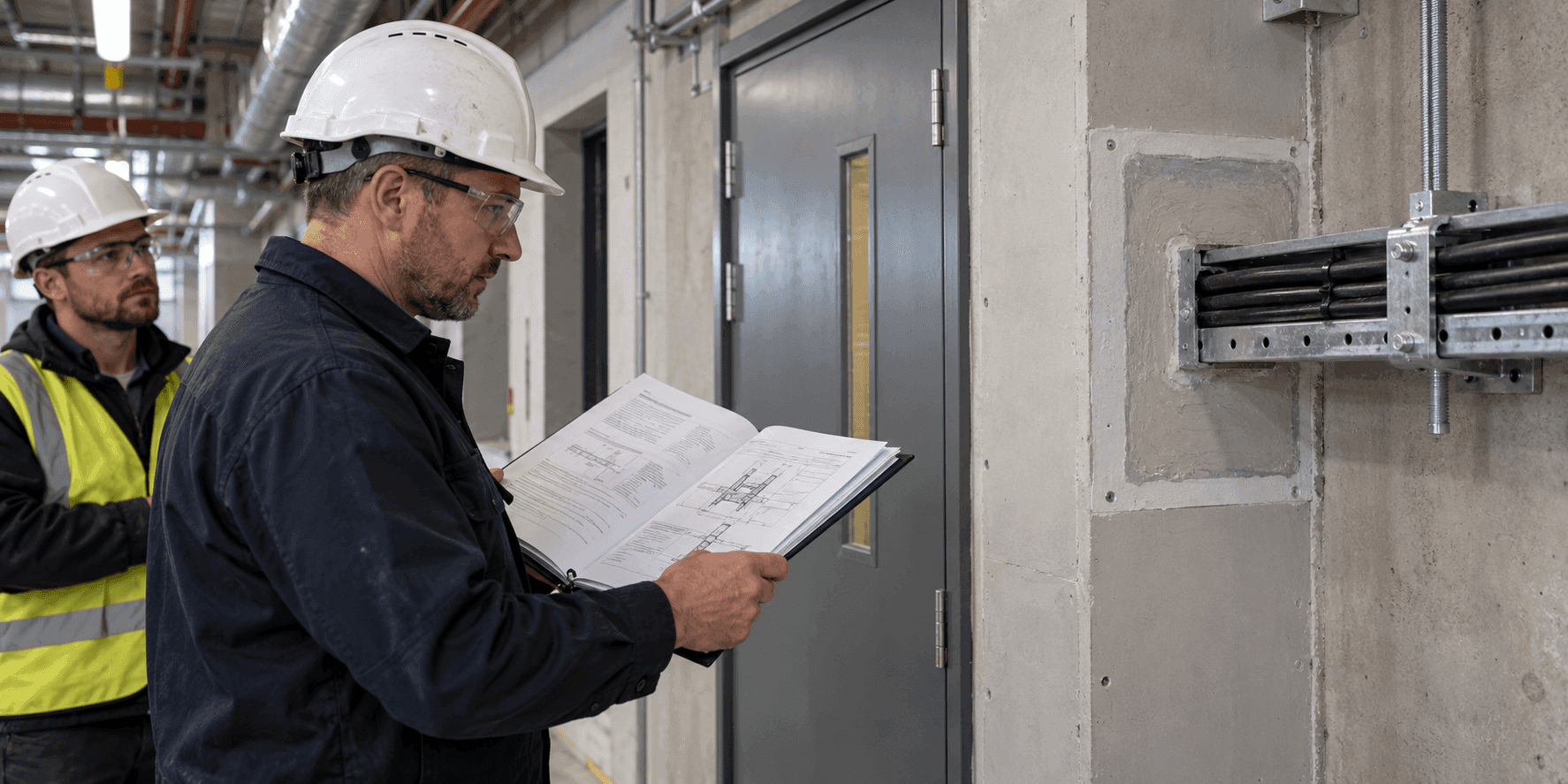
For fire and blast doors, establish the required post-event condition explicitly. A door that retains its leaf and frame may still need repair before it can operate.
Fire performance also requires applicable evidence; the blast result does not establish it.
Put the Complete Loading Basis in the Specification
Before procurement, confirm:
- The credible explosion scenario and protected asset.
- Incident or reflected pressure basis, as applicable.
- Peak overpressure, impulse and duration.
- Required waveform and loading distribution.
- Proposed dimensions, supports and connections.
- Permissible deformation, damage and debris.
- Any required post-event operation.
Keep the units and definitions consistent across calculations, schedules and supplier submissions.
Where proposed evidence differs from the design scenario, obtain an appropriate engineering assessment. Matching a single pressure number is insufficient.
The useful requirement describes the load and the acceptable response together. That gives engineers a sound basis for selecting a complete system against the exposure it must resist.