Bollards, Blockers, Gates and Barriers — Which Fits the Site?
Bollards, Blockers, Gates and Barriers — Which Fits the Site?
A delivery entrance, public forecourt and maintenance access route may belong to the same facility, yet require different vehicle-security arrangements. Each presents a different combination of access, pedestrian movement, available space and installation constraints.
Choosing between bollards, blockers and gates therefore starts with the location’s purpose and assessed threat. Product type describes its form and operation; it does not establish impact resistance.
The right selection connects demonstrated barrier performance with an arrangement the site can operate and maintain.
Start With the Access Requirement
Define which vehicles need access, how often they arrive and how they will be authorised. Include emergency services, abnormal loads, maintenance activities and occasional equipment replacement.
Establish the necessary clear width and manoeuvring space. A barrier that accommodates routine cars may obstruct larger vehicles or require changes to pedestrian routes.
Government streetscape guidance identifies security requirements and operational needs as the basis for selecting vehicle security barriers. assets.publishing.service.gov.uk
Record these requirements within the wider security systems brief. This allows barrier selection, access controls and operating procedures to develop together.
Bollards Where Pedestrian Permeability Matters
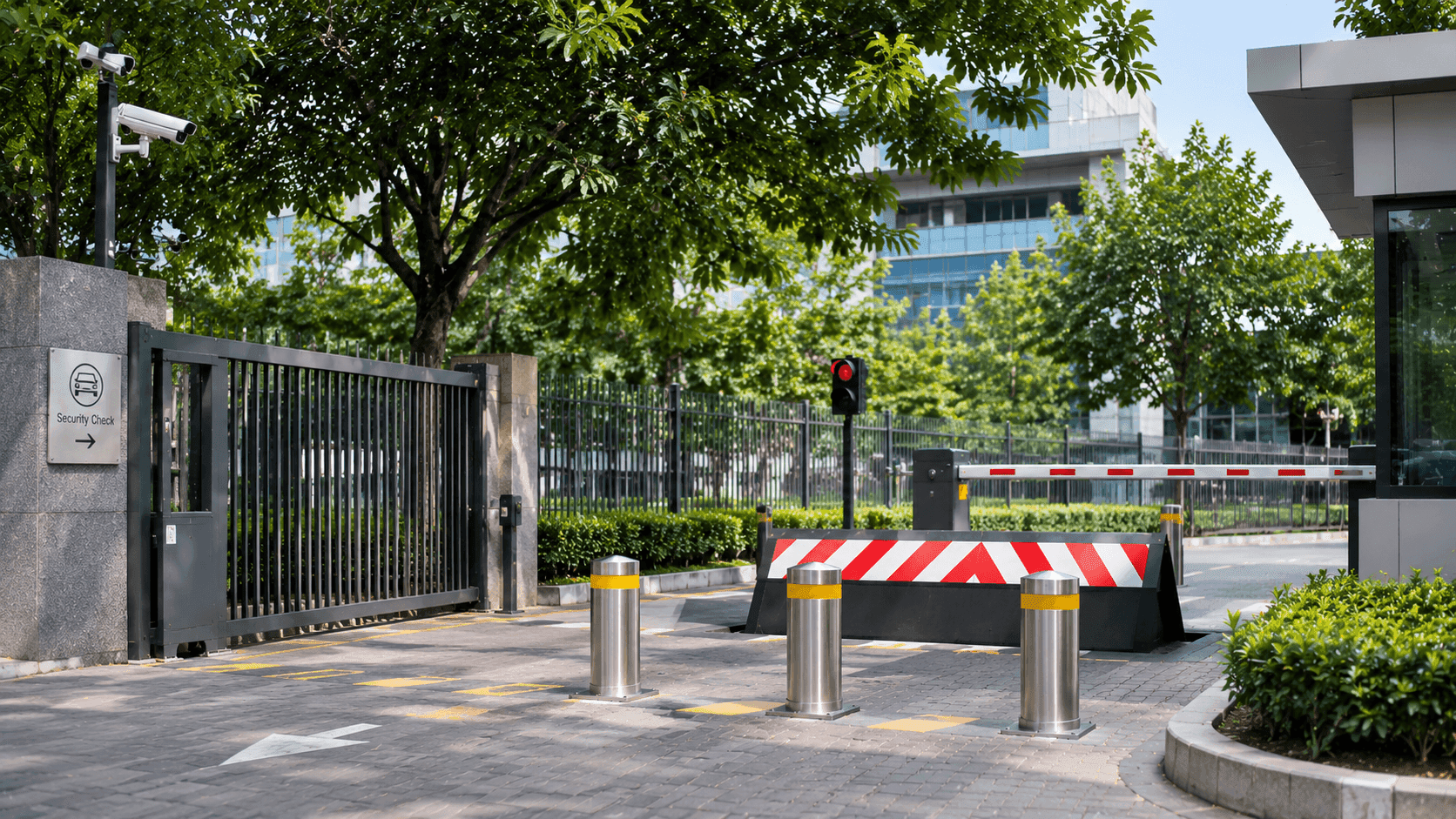
Bollard arrangements can restrict vehicle access while allowing pedestrians to pass between individual units. They may suit public-facing boundaries where a continuous solid barrier would interrupt movement.
Fixed bollards provide a static arrangement. Retractable or removable designs can accommodate vehicle passage, subject to their operating and installation requirements.
Spacing needs coordination with the vehicle threat, accessibility and pedestrian flows. The assessed configuration must remain applicable to the proposed arrangement.
Consider visibility, queues and movement during evacuation. A layout that works during quiet periods may behave differently when large numbers leave a building simultaneously.
Bollards should be evaluated as a scheme, including end conditions and adjacent routes through which vehicles might otherwise pass.
Road Blockers at Controlled Vehicle Openings
Road blockers typically provide an operable obstruction across a vehicle lane. They can suit access points where vehicles need to pass through a defined opening.
Assess the clear width, approach surface, vehicle clearance and position of the equipment relative to pedestrians. Below-ground mechanisms may introduce requirements for excavation, drainage and maintenance access.
Define the protective position, operating sequence and monitoring arrangements. The protection represented by an impact test should not be assumed available while the blocker is lowered or moving.
Review the surface condition around retractable equipment. Changes in grip, drainage or level can affect everyday vehicle and pedestrian safety.
Gates Where the Boundary Must Also Control Access
A gate can provide a continuous boundary while opening for authorised movements. Swinging, sliding, folding and rising arrangements have different space and operational demands.
Check the swept area, storage space, tracks where applicable, gradients and interface with nearby fences or walls. These details can determine whether a proposed gate fits the location.
A gate controlling routine access is not automatically a vehicle security barrier with demonstrated impact resistance.
Where impact performance is required, confirm evidence for the proposed gate dimensions, supports, locking arrangement and foundations. Increasing the opening width or changing the support detail needs appropriate review.
Also establish how pedestrians enter without sharing an unsuitable moving-gate zone.
Consider Other Barrier Forms Without Assuming Performance
Impact-rated systems can take forms such as reinforced street furniture or purpose-designed landscape elements. Their appearance may help integrate protection into the public realm.
Ordinary planters, benches and walls should not be assigned equivalent resistance based on weight or appearance.
Temporary or surface-mounted systems may address locations where permanent works are unsuitable, but they also have defined deployment conditions. Review connections, layout, supporting surface and access requirements against applicable evidence.
The same assessment applies to transitions between different barrier types. The boundary must remain coordinated across those junctions.
Let Installation Constraints Inform the Decision
Underground services, foundation depth, ground conditions and drainage can narrow the suitable options.
Resolve these constraints before procurement. A product selected around its visible dimensions may require civil works that the site cannot accommodate.
For operable systems, include power, controls, duty cycle, fault behaviour and emergency access. For every option, establish inspection and repair arrangements.
Before selection, confirm:
- Defined vehicle threat and approach conditions.
- Suitable impact evidence and penetration results.
- Required access width and frequency.
- Coordinated pedestrian and emergency routes.
- Achievable foundations and installation details.
Clear operating and maintenance responsibilities.
A physical security protection scheme may combine several barrier forms. Their value comes from how each resolves its location’s requirements while maintaining a coordinated protected boundary.