Why Approach Speed Matters in Vehicle-Barrier Design
Why Approach Speed Matters in Vehicle-Barrier Design
A vehicle security barrier is tested under defined impact conditions, including vehicle mass, speed and angle. Selecting a suitable system therefore requires an assessment of the conditions a hostile vehicle could achieve at the proposed barrier line.
The speed displayed on a nearby sign does not establish that design condition. Neither does the speed at which authorised vehicles normally enter the facility.
Approach speed must come from a credible assessment of the vehicle threat and site geometry. Otherwise, even a correctly installed impact-rated barrier may be specified against an unsuitable scenario.
Speed Changes the Impact Demand
Kinetic energy is proportional to vehicle mass and the square of velocity. For the same mass, doubling speed produces four times the kinetic energy.
This explains why speed deserves attention early in design. However, kinetic energy alone cannot predict whether a particular barrier will resist an impact.
Vehicle construction, impact angle, contact geometry and the interaction between vehicle, barrier and foundation also influence the outcome. Equal calculated energy does not establish equivalent test conditions.
Use energy calculations to understand the significance of speed, then assess suitability through applicable barrier evidence and project-specific engineering.
Assess Achievable Speed Rather Than Permitted Speed
Normal traffic controls rely partly on driver cooperation. A hostile approach cannot be assessed on the assumption that the driver observes signs, signals or normal traffic direction.
NPSA’s vehicle dynamics guidance specifically addresses these assumptions when examining credible approaches. NPSA
A vehicle dynamics assessment should consider relevant vehicle capabilities and site conditions. These include acceleration distance, cornering, gradients, surfaces and the geometry of potential routes.
The assessment should identify its assumptions and limitations clearly. A speed estimate without a defined route, vehicle scenario or supporting method provides a weak basis for procurement.
Examine the Whole Approach
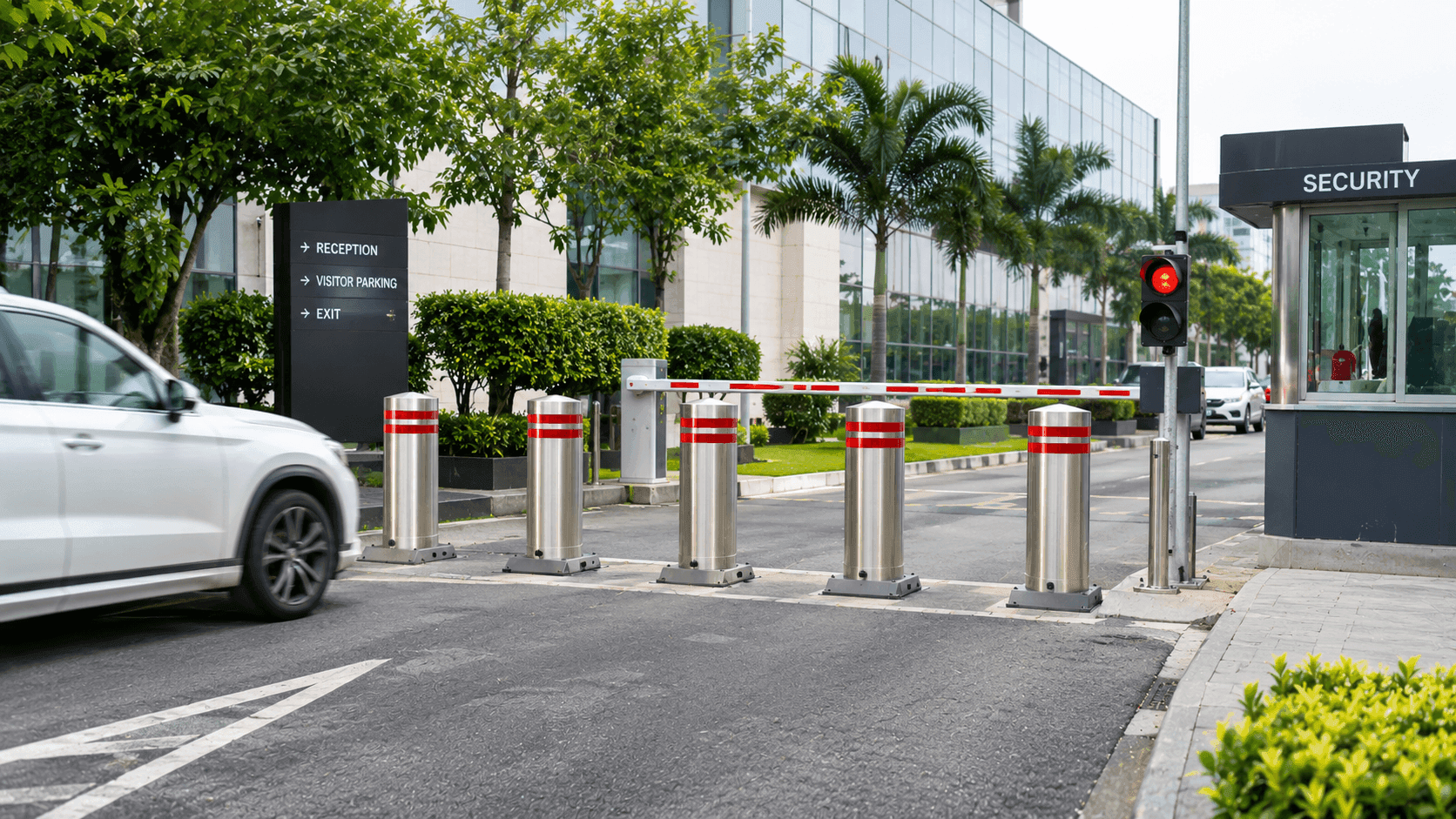
A barrier’s location can change the available approach and resulting impact conditions.
Review the surrounding road network, entrance layout and accessible areas around the proposed boundary. The assessment should consider credible routes beyond the one normally used by deliveries or visitors.
Do not assume that parked vehicles, movable furniture or temporary obstructions will remain available as protective features.
Likewise, a kerb, planted area or paved pedestrian surface should not automatically be treated as preventing vehicle access. Any feature relied upon to constrain the approach needs an appropriate engineering basis.
These findings should inform the wider security systems design and the location of protected assets.
Use Site Geometry as a Design Input
Layout changes can reduce the opportunity for a direct, high-speed approach. NPSA’s public-realm guidance illustrates how route alignment and asset location influence vehicle access towards a target. npsa.gov.uk
The effect needs assessment rather than assumption. Adding a bend or offset does not establish a particular reduction in impact speed.
Review the proposed geometry against relevant vehicle dimensions and handling capabilities. Also consider legitimate delivery access, emergency vehicles, pedestrian routes and queues.
Where a feature is relied upon to control the approach, document its required arrangement and maintain it through later site changes. Removing or relocating it may alter the original design basis.
Match the Assessment to Barrier Evidence
Translate the assessed approach conditions into a clear performance requirement.
Review the proposed barrier’s evidence for vehicle class, mass, speed, impact angle, penetration and other applicable results. Confirm that its configuration and foundations are suitable for the installation.
A rating at a higher speed does not independently resolve differences in vehicle class, opening width, foundation arrangement or allowable penetration.
Similarly, a barrier assessed against one approach should not automatically be accepted for every position along the boundary. Different locations may present different impact angles or vehicle scenarios.
Keep the assessment, specification and installation drawings coordinated so that they describe the same protective arrangement.
Preserve the Assumptions After Installation
Approach conditions can change during the facility’s life.
Road widening, entrance relocation, removal of landscaping or creation of a new service route may affect the speed achievable at the barrier. Temporary construction layouts also need consideration.
Before accepting the design, confirm:
- Protected assets and credible vehicle threats.
- Assessed approach routes and achievable speeds.
- Relevant impact angles and vehicle characteristics.
- Layout features relied upon for mitigation.
- Applicable barrier evidence and installation requirements.
- Responsibility for reviewing future changes.
Retain the vehicle dynamics assessment with the security records and identify the features on which it depends.
Approach speed is a relationship between the vehicle, route and barrier location. Maintaining that relationship keeps the installed protection aligned with the conditions it was selected to address.